

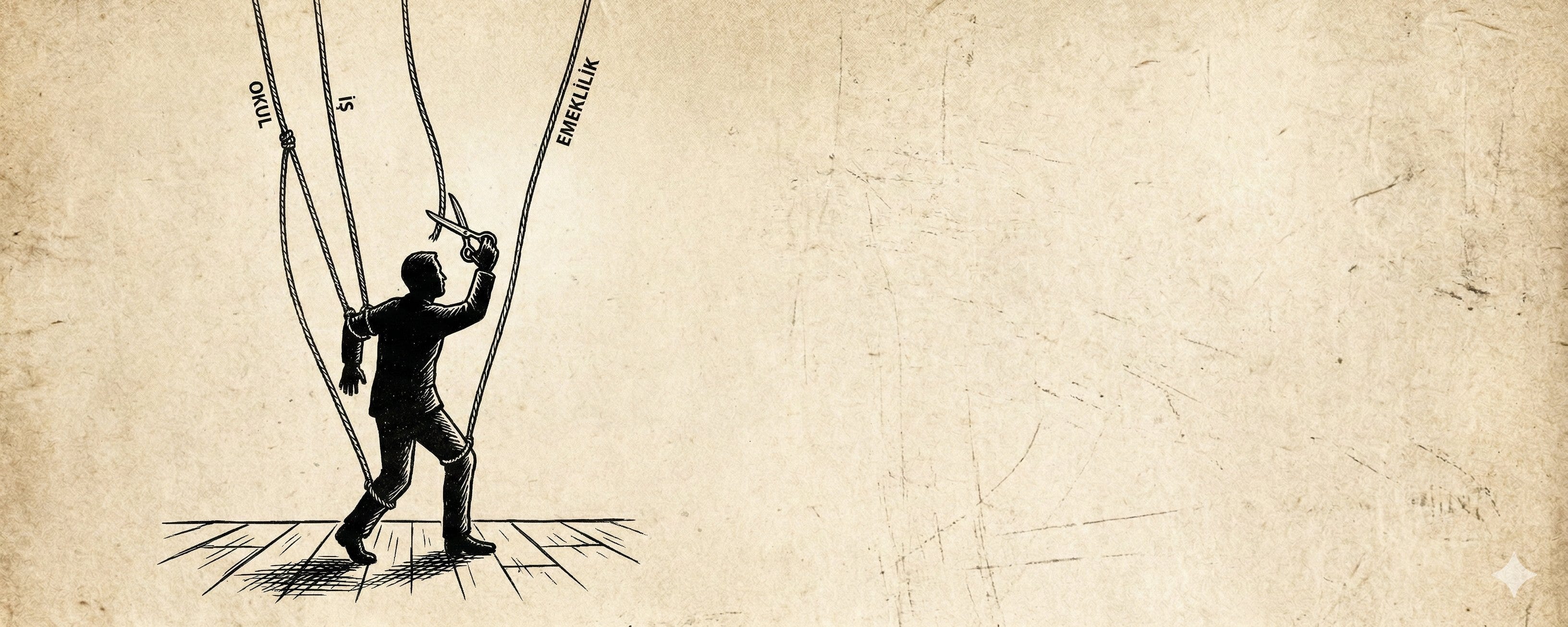
“The scariest thought in the world is that someday I’ll wake up and realize I’ve been sleepwalking through my life: underappreciating the people I love, making the same hurtful mistakes over and over, a slave to neuroses, fear, and the habitual.”
George Saunders
People look like they’re “choosing.” But most people are just running their habits.
Because as a child, you were handed goals.
School → Job → Retirement
Society called this “the good life.” And you accepted it before you even learned to question.
But here’s what we missed:
A goal means a system.
To reach a goal, you build a system. The system gets efficient through trial and error. Then the system carries you.
How the “Impossible” Becomes Automatic
There was a time you couldn’t walk.
You crawled. You fell. You wobbled. You learned to balance.
Your environment gave you feedback: it got angry, corrected you, showed you the way.
Today, walking feels simple.
Just like Alysa Liu spinning three and a half times in the air and landing it flawlessly... With enough (and correct) practice, things that once felt impossible become ordinary, fluid, almost effortless for you.
[Embed: Susan Li @SusanLiTV, Feb 19: “Congrats Alyssa Liu! Olympic gold”]
Walking was just the beginning.
But what about these goals?
Go to school
Find a good job
Earn a high salary
Retire
Live, if there’s any time left
This template is not innocent.
Modern society’s system wants useful workers and obedient citizens.
[Embed placeholder: original post unavailable, re-add or delete]
Because without them, authority weakens.
And these goals were carved into your mind while you were still learning to speak.
99% of People See 1% of Reality
Most people don’t see reality as it is. They only see the part that confirms their beliefs and leads them toward the “standard life.”
The result?
Most people’s life energy drops before they turn 25. Because the same systems chasing the same goals only get stronger with age. And efficiency in service of the wrong goal is a disaster.
The truth people realize too late:
Success isn’t planned. Success becomes automatic.
Most successful people, consciously or unconsciously, have been “programmed” with systems built for success.
Now the critical question:
How do you take your mind apart and reprogram it?
The Root of Human Behavior (And Why You Can’t Change)
Your identity is not “you.” Identity is software your brain wrote to survive. And for the brain, survival doesn’t just mean “not dying.”
Not falling behind. Not being rejected. Not losing control.
That’s why change is hard.
Because in the brain’s eyes, change means one thing:
“There is risk.”
Waking up early? Comfort is gone. Risk. Starting a business? Uncertainty. Risk. Dieting? Pleasure is gone. Risk. Being social? Possibility of rejection. Risk.
And when the brain sees risk, it does exactly one thing:
It pushes you back to your old self.
That’s why your thoughts, your emotions, your reactions... most of the time, they’re not “you.”
They’re survival automation.
Your current life is the result of it too.
You can’t “win” against your identity. You can’t beat it.
There’s only one thing you can do:
Notice it. Rise above it. Take back control.
The more you try to “win” at survival, the more it hurts. Because that game never ends.
But when you rise above it... the game changes.
Why Do People Defend Their Beliefs Like Their Lives?
Animals survive on a physical level. They pass on their genes.
Humans do that too, but they do one more thing:
They keep their identity alive.
So it’s not just the body... They also protect the story of “who am I?”
Your beliefs, your values, your worldview, your image... The mind defends these like life itself.
Because to the mind, a threat to identity is a threat to life.
That’s why people cling to ideologies, teams, diets, labels.
Criticize women, and the feminist goes on defense
Hand men responsibility, and the incel goes on defense
Touch a political view, and the attack begins
Criticize a diet, and a fight breaks out
Say “gaming is harmful,” and the gamer goes on defense
Here’s the problem:
This process usually runs mechanically. Automatic. Unaware.
So your life ends up made of reactions, not choices.
Why Is Changing Your Life So Hard?
Your identity is like a house. You’ve lived in it for years. You know every room by heart.
Now you’re saying, “I’m going to change my life.”
But most people try to change by tearing down the walls overnight.
The result?
The house shakes. The mind panics. And you run back.
Because those walls aren’t just decor. They’re your sense of safety.
You want to wake up early: “I’m a night person.” You want to start a business: “I’m an employee.” You want to eat healthy: “This is just how I am.” You want to be social: “I’m an introvert.”
These sentences are not real. They’re your identity’s self-protection system.
The mind doesn’t read this as “growth.” It reads it as “threat.”
That’s why change hurts.
The solution is simple:
Don’t demolish the foundation. Do small renovations.
First fix the floor. Then tidy up one room. Then change one small wall.
Over time the house changes, and without noticing it, you become “someone new.”
Comfort seems to protect you for a while. But if you stay too long, the inside of the house grows mold.
Because no system gets better on its own. Without maintenance, it decays.
The mind is the same.
The Mastery Method (For Learning Anything Fast)
If you want to learn something to the point of mastery, accept this:
New mastery means killing your old self.
Because what you master changes you.
It demands new habits. It demands new standards. It demands a new environment.
But your old identity resists all of it.
“I’m a night person.” “I’m just like this.” “That’s my nature.”
These aren’t character. They’re defense mechanisms.
That’s why learning isn’t just taking in information. Learning is changing identity. This is why education is powerful:
It expands your mind.
It gives you new perspectives.
It supplies your brain with steady energy (not motivation, fuel).
It sharpens your goals.
It makes options visible that you couldn’t see before.
Everything you learn does one of two things. It either strengthens your old survival pattern or helps you transcend it. Right now, you’re a master at staying the same. The new goal is to become a master at changing.
1) Expand Your Mind: A Big Goal Exists to Grow You, Not to Be “Achieved”
Real change doesn’t happen outside. It happens in your identity.
Whatever your identity sees as normal, you live. Whatever your identity sees as impossible, you can’t even approach.
Here’s the problem:
Most people’s minds run in a narrow mode. Always the same filter:
Is this useful to me?
Does it put me in danger?
What will people say?
What if I fail?
This isn’t “bad intent.” This is survival mode. And when survival mode is on, your life shrinks.
The exit door: throw a goal into the unknown.
The fastest way to expand your mind is this:
Pick a “big” goal for yourself. But not the kind everyone picks.
A big goal’s real function is not “reaching the outcome.”
A big goal’s function is this:
To force you into becoming a new person.
If a goal doesn’t grow you, it’s not a goal. It’s just a to-do list.
Where do you pick from?
Choose one of 4 areas:
Mind (learning, creating, writing, thinking)
Body (fitness, strength, energy, discipline)
Spirit (meaning, inner peace, practice, awareness)
Career (money, skills, business, projects, freedom)
The easiest starting point is usually body or career.
Because when energy rises, everything rises. When money grows, your options grow. When options grow, the mind opens.
The “logical goal” mistake
When people pick goals, they think:
“This is the most logical.” “This is the safest.” “No risk here.”
And then 5 years pass. Same person.
Because logical goals usually do one thing:
They protect you. But they don’t grow you.
What you need isn’t protection. It’s expansion.
What does a big goal actually do?
A big goal is a perspective machine. Problems show up along the way. You solve them. While solving them, you gain a new way of thinking. That new thinking changes “you.”
That’s why:
The road to the goal updates you.
The real reward isn’t the “outcome.” The real reward is the death of your old self.
5 questions to clarify your vision
If you’re confused, start here:
If you had unlimited money, how would your day look?
Where would you live? In what kind of environment?
How many hours a day would you work, and on what?
How would you want to look and feel?
Write out your ideal day: morning, noon, evening.
This vision becomes your compass.
Anti-vision (the real fuel is here)
Now write the opposite:
What would the “hell” version of your life look like?
Which life would rot you from the inside?
What happens if you live like this for 2 more years?
When you write it down, you’ll realize something:
You’re not running away from some things. You need to run toward some things.
Without a vision, “everything” looks like an opportunity
When the vision gets clear, the game changes.
Because now you do this:
No to everything that doesn’t align.
This isn’t a simple discipline sentence. This is an identity sentence:
“I’m on my way to becoming that person. This thing doesn’t take me there.”
2) Clarity, Not Motivation
You don’t need motivation. You need clarity.
When motivation shows up, you work. When clarity exists, you’re already working.
Your big goal isn’t there for “achievement.” It’s there to point the direction.
Your small goals aren’t there for “dreaming.” They’re there for making progress.
Now:
Write your 10-year goal
Then write your 1-year goal
Write your goal for this month
Now write your goal for this week
Then every morning:
Write 3-5 critical tasks. And finish them before the day has even really started.
This habit changes one thing: no more reactive living, only productive living. Not “firefighting” but “building.”
3) Real Learning: Doing, Not Watching
People think they’re “learning.” What they’re actually doing is stalling.
Watching tutorials makes your brain feel like “look, we’re making progress.” But there’s no progress.
Because there’s no risk. Because there’s nothing real. Because there’s no result.
Learning doesn’t happen through memorizing. It happens through crawling.
Meaning:
You try something. It doesn’t work. You see why it didn’t work. You fix it. You try again.
This loop is learning.
School-style learning is safe. It protects your identity. Real learning is dangerous. It attacks your identity.
Because real learning screams: “What you know right now isn’t enough.”
That’s why it’s uncomfortable. And most people watch more videos to escape that discomfort.
The solution: turn your goal into a project
If you want to learn, pick a project.
A project means something with an outcome.
Write one page, create one piece of content, write one proposal, design one product, find 1 customer, lose 1 kilo, run 10K...
Then break it down: set milestones (step 1, step 2, step 3), take notes (what did I try, what happened?), start again.
Once you start, “what you need to learn” reveals itself.
Because a project collides you with reality.
You get stuck somewhere. That’s the moment Google opens. That’s the moment the tutorial gets watched.
But this time the difference is:
You’re not watching the video “for information.” You’re watching it to solve a problem.
That’s why it sticks. That’s why it works. That’s why you level up.
Do first. Learn after. Then fix.
4) Learn Techniques, Not Skills
People progress slowly because they try to learn “skills.” But a skill isn’t one single thing. A skill is a combination of techniques.
There’s no such goal as “learning Photoshop.” There are techniques that let you get work done in Photoshop.
For example, “removing a background.”
There are 10 different ways to do it:
Quick selection
Masking
Pen tool
Channels method
Layers
AI selection...
If you know one method, you get stuck on a difficult image. If you know 5 methods, you solve it immediately.
Writing is the same.
“Learning to write” is a vague goal. Because writing isn’t one single thing. Writing is the sum of writing techniques.
What actually matters:
Writing strong openings (the hook)
Keeping the flow (rhythm + transitions)
Turning the abstract into the concrete (examples, metaphors, scenes)
Compressing the idea (cutting the unnecessary)
Creating clarity (a one-sentence thesis)
Pushing the reader to the next line (curiosity, tension, questions)
The more techniques you know, the more options you have. As options grow, “locking up” while writing shrinks.
Because you’re no longer waiting for inspiration. You know what to do.
If you have one technique, you get stuck in the same spot in every piece. If you have a workshop, you reach for a different tool at every blockage.
5) Starve the Old Identity, Feed the New One
Your mind works like a digestive system. Whatever you consume, you become.
Consume too much information and you bloat but don’t get stronger. (Lots of content, little application.) Consume too little and you weaken. (No direction, no energy.) Consume the right dose and you grow. (Enough information + enough practice.)
Reinventing yourself isn’t a “new me” decision.
It’s something more precise:
The controlled death of the old identity. The controlled birth of the new one.
How do you kill the old identity?
The old identity doesn’t die by willpower. It dies when its food supply is cut.
3 things feed the old identity:
People
Environment
Information flow (your phone, content, conversations, the news cycle)
If you don’t change these, “I’m going to change” stays a wish.
1) Change your environment
Same place, same people, same routine, same you.
New gym
New workspace
Maybe even a new city
2) Clean up your online space
Your phone is the home of your consciousness level.
Unfollow everyone who feeds the old identity
Turn off notifications
Rebuild your feed for the “new you”
3) Follow people who match your future self
Whoever you’re watching, your mind picks its goals accordingly.
4) Update your clothes / habits / social plans
Changes that look small are identity signals.
Dress differently
Wake up earlier
Shop somewhere else
Meet different kinds of people
5) Dive into the books you’ve been postponing
A new identity comes with new thinking. New thinking demands new input.
The rule is simple
If the old identity can’t find the information and environment that feed it, it weakens automatically. The new identity, with the right input, strengthens automatically.
So this isn’t about forcing yourself. It’s about building a system. The system changes the identity.
6) Mistakes Are Nature’s Compass
A mistake isn’t bad news. A mistake is feedback.
The universe is telling you: “This method didn’t work.”
Most people read a mistake as “I am bad.” So they stop trying.
The correct reading is:
I’m not bad
The method is bad
Change the method and the result changes
This is how self-driving cars learn: wrong → correct → try again.
You’ll learn the same way: try → get it wrong → fix → try again.
7) Experiments: The Only Path to Lasting Solutions
You don’t fix your life with “advice.” You fix it with experiments.
Because advice gives you an identity. An experiment gives you a system. And a system is stronger than an identity.
1) Predict “I want this outcome.” (goal)
2) Try Apply a few methods. (techniques)
3) Measure What happened? How much? When? (data)
4) Keep / discard Scale what works. Drop what doesn’t. (system)
That’s it.
When you do this, here’s what you’re left with:
experience (real-world proof)
skill (the muscle of application)
records (a process you can transfer to others)
solutions (which can turn into products / services)
Why is this so critical?
Because people worship “methods.” The moment they get a result, they turn it into an identity.
“Carnivore fixes everything.” “Keto is the one true way.” “Sugar is poison.” “Carbs are the enemy.”
That’s not a solution. That’s tribalism.
And tribalism is the enemy of conscious growth.
The six-pack example
Let’s say your goal is: visible abs.
Someone tells you: “Go carnivore, everything gets fixed.”
You go carnivore. You lose weight. You feel good.
Then the mind says:
“So the solution is carnivore.”
No.
The solution wasn’t carnivore.
The solution was:
you ate less junk food
you ate more consistently
you built discipline
your calorie/balance awareness went up
The result came from principles, not from the “method.”
But once you attach yourself to the method:
You become a “side” without ever learning the principles.
The more mature approach: test the methods, find the principle.
Do this:
Try carnivore for 2-4 weeks
Try vegan for 2-4 weeks
Try keto for 2-4 weeks
Try intermittent fasting for 2-4 weeks
Measure the same things every time:
weight / waist size
energy
hunger
performance
sustainability (the most important one)
Then ask:
“What’s the common thing that works for me?”
The moment you find the common thread:
No one can manipulate you anymore. Because you’ve become a person of principles, not a person of methods.
The same logic transfers to every area
If nutrition works this way... So does money. So do relationships. So does social life. So do spiritual practices.
Everything is the same game:
Experiment → data → system → freedom.
The Mastery Method
Expand your mind with a vision
Create clarity with a goal hierarchy
Turn goals into projects: learn by building
Collect techniques, not skills
Change your environment: kill the old identity with new input
Use mistakes as data
Turn your life into experiments: measure, record, improve
Six months from now, you won’t be the same person.
Because you’re no longer living on autopilot. Now you’re the one building the system.