


Slowing down won’t save you.
The fast system already made the decision. The slow system is just the defense attorney.
Here’s the pop version: System 1 is dumb and biased. System 2 is smart and rational. Making mistakes? Slow down and think.
Sounds logical. Even scientific. But it’s wrong.
Your fast reactions are not wiring errors. They are your lifestyle (Lebensstil) running on autopilot. And your slow thinking is, most of the time, that autopilot’s lawyer.
So the fix is not to slow down. The fix is to ask what the reaction is for, then train the autopilot.
Three things here. How the slow system looks like a referee but works for a client. What your fast reactions serve, with a six-item test. And a protocol that trains your autopilot, starting this week.
The Pop Version Is Right in a Small Way and Wrong in a Way That Runs Your Life
Credit where due. Daniel Kahneman carried this distinction to millions with Thinking, Fast and Slow in 2011. The terms came earlier, from Stanovich and West.
System 1 is fast, automatic, effortless: you read anger on a face in a glance. System 2 is slow, deliberate, tiring: 17 times 24, a contract footnote. You need both. Run everything through System 2 and you never leave the house.
Quick test. A bat and a ball cost $1.10 together. The bat costs $1 more than the ball. How much is the ball? Look at the first number that showed up.
Probably 10 cents. The right answer is 5. Shane Frederick put it into the Cognitive Reflection Test in 2005, because the fast system hands you an answer instantly and it’s wrong.
The pop version stops at “See? The fast system makes mistakes.” I don’t. What did you do first when you found out the right answer?
“It was a trick question.” “Anyone normal would say 10.” “I was rushing anyway.”
Who wrote those sentences? Not the fast system. The slow system, and within seconds.
Slow Thinking Is Usually the Attorney, Not the Referee
The pop version treats System 2 as a referee: neutral, weighing evidence. It doesn’t work that way. The verdict comes from the fast system. The slow system writes the reasoning. I call it the autopilot attorney.

An attorney’s job is not to find the truth. It’s to defend the client. And he’s good at it: slow, meticulous, knows the words. Picture a chef. A new ordering system shows up, and in the first minute he says “this won’t work.” By night he has three reasons: slow, expensive, the team won’t adapt. All three may be true. But the reasons didn’t make the decision. The feeling of losing control did. It’s salting the sauce at the end: you missed the flavor at the start.
Tell the attorney to slow down and what happens? He writes a longer defense.
The problem is not speed. The problem is that you can’t see who the client is.
Even Kahneman Lost to His Own Attorney
It happened to the man who explained the two systems to the world. Kahneman gave a chapter of his book to priming: a small cue you don’t notice changes your behavior. The famous example: people read words about old age, then walk more slowly out of the room. He told readers flatly that disbelief is not an option.
Then other teams ran the same experiments. The results stopped showing up. In 2012 Kahneman wrote an open letter to researchers in the field and said he saw a train wreck looming. He asked them to replicate each other’s experiments. Years later it came out that most studies in that chapter used very few participants. He admitted it: he had placed too much faith in underpowered studies.
The man who wrote the book on fast and slow thinking used his slow system to defend a fast verdict. The distinction didn’t collapse. The story that unconscious cues steer you by remote control did. The lesson: Intelligence doesn’t fix the attorney. It just hires a more expensive one.
Now look at yourself. Think of something you were absolutely sure about. Did every new thing you read make that belief stronger? Probably. The attorney never clocks out. Find the last time you backed down in an argument. Can’t? Then you’re not short on information. The attorney has one client, and you’ve never said “no” to him.
The Gorilla Test: Paying Attention Is Not the Same as Seeing
Chabris and Simons showed viewers a short film of two teams passing basketballs. The task: count the white team’s passes. Midway through, a person in a gorilla suit walks in, thumps their chest, and walks off. Many viewers never saw the gorilla.
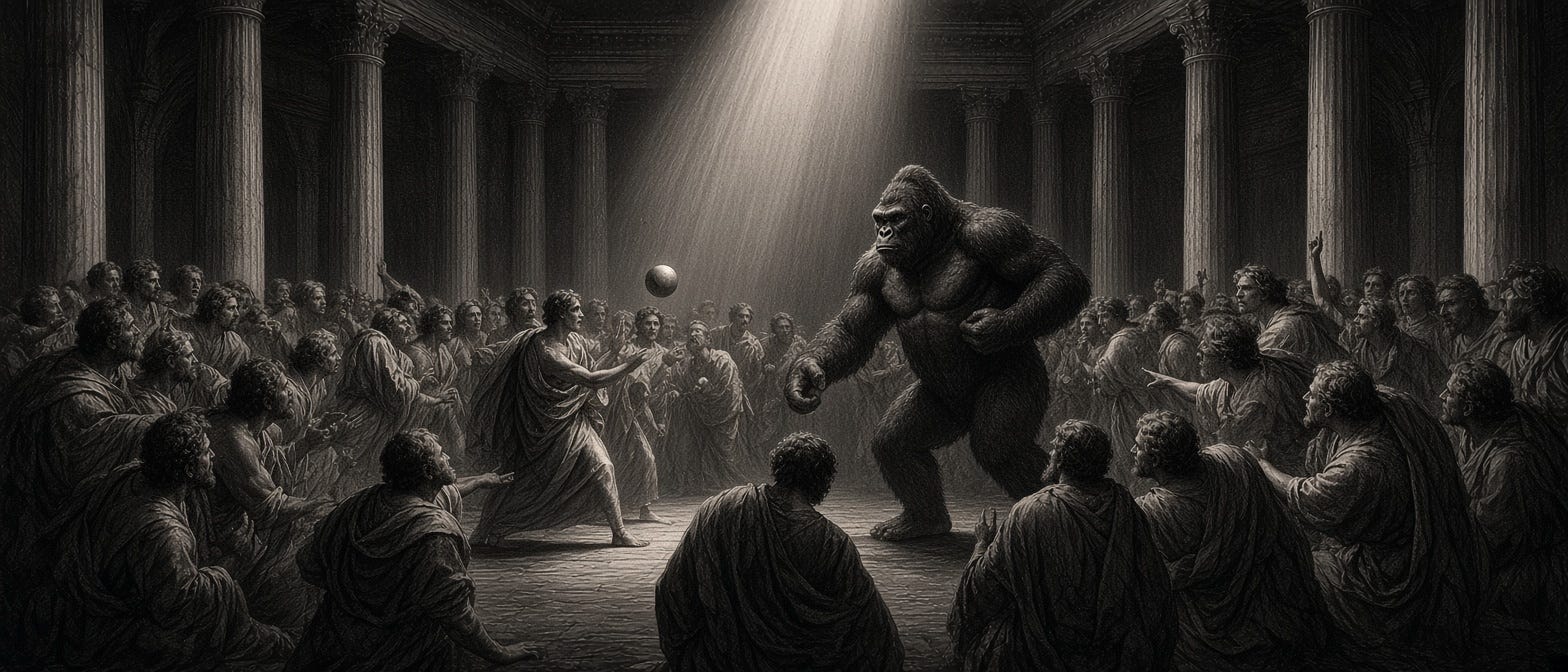
These people were not lazy. They were doing slow, deliberate, effortful work. The client said “count passes,” the attorney counted passes, and he missed a gorilla in the middle of the screen. The slow system didn’t protect them. It narrowed them.
You’re counting passes too. In an argument you don’t listen. You pick which sentence to answer. You miss the gorilla: what the person is actually telling you.
The Willpower Muscle Story Fell Apart Too
Kahneman describes System 2 as the part in charge of self-control. Beside it walked a second idea: willpower tires like a muscle (ego depletion). A multi-lab effort led by Hagger looked for the effect in 23 labs. It didn’t show up. The debate goes on, but the ground under “try harder, slow down more” isn’t solid.
And I have to say this. There’s a giant industry built on it. Slow down, breathe, be mindful, morning routine, five minutes of meditation. Same promise every time: the problem is speed, the cure is slowness. Plenty of people make wrong decisions very calmly. The guy who breathes and slows down keeps defending the same client, just calmer. Calm doesn’t make you right. It makes you defend your mistake more politely. The people selling it don’t want you fixed. Fixed people don’t buy the next course.
See willpower as a fuel tank and you’ll blame yourself when it runs dry. The problem isn’t the tank. You keep fueling the attorney.
Your Fast Reaction Isn’t Random: The Autopilot Serves a Purpose
Evolutionary psychology has an answer, and I think it’s right: the human brain was shaped over 200,000 years in small tribes. Speed was survival. Whoever stopped to think about the rustle in the bushes didn’t live.
Adler adds a layer. Next to “why,” he puts “what for.” That’s teleology: behavior serves a purpose. Evolution gave you the fast system. Adler shows what it works for. Since childhood you’ve been giving meaning to what happened to you: what the world is like, who I am, what I must do to stay safe. Those meanings build a personal plan of movement. Adler calls it lifestyle (Lebensstil), and its inner logic private logic.
Now put that on the two systems. Your fast reaction is that plan running on autopilot. The defensiveness under criticism. The tightness in your chest when a reply comes late. The “too expensive” that pops out at a price list. None of it is random. All of it serves something, and that is where the attorney’s client sits.
Adler didn’t see conscious and unconscious as separate forces either. What you think and what you do automatically work toward the same goal. Fast and slow aren’t two people fighting. They’re one person facing one direction.
Diagnose Your Own Autopilot: Six Reactions and What’s Under Them
Save this list. When a reaction hits, see it, then ask what purpose sits under it.
“Too expensive.” Most of the time it has nothing to do with the price. It’s about holding on to control and protecting yourself from a mistake.
“I’ll handle it.” Not wanting to look needy. The math behind it: “If I ask for help, my value drops.”
Going defensive when criticized. That “but I did this” is the voice of the need to be right. Underneath, most of the time, is the fear of being worthless.
Seeing the message and replying late on purpose. Superiority or punishment? Ask yourself.
Saying “fine” and swallowing the no. “Let me not drag this out, let me avoid trouble.” Wanting to be liked, dodging conflict.
“I need to prepare a bit more.” Escaping the test. Preparing is the imaginary substitute for acting.
Every line has an answer, and the one you don’t like is usually the right one. This isn’t an accusation. It’s a map.
So What Do We Do in the Kitchen? Fast Model, Slow Model, Escalation Rule
I see this in the restaurant every day. On a Saturday service nobody stops to think “how was this sauce made again.” The hands know. The autopilot has to run, or service stalls. But when a server says “allergy at the table,” the autopilot stops and the question goes to the chef. That’s the rule of a good kitchen: routine decisions go to the autopilot, uncertain decisions go up.

Machines got to the same place in 2026. While designing Usta’s AI architecture, I came across TypeSafe’s Jev, introduced as the first “System One model,” named after Kahneman. Instead of writing long text, it returns typed decisions and probabilities. When confidence is low, the decision goes up to a human or a reasoning model. Usta works the same way: routine, narrow decisions go to the fast, cheap model, and uncertain exceptions go to the slow model or a human.
I think this is the most important psychology lesson of 2026, and a software company delivered it. Nobody tells the fast model to “slow down.” They give it an escalation rule.
Does your autopilot have one?
The 7-Day Autopilot Training Protocol
You can’t get rid of your autopilot. You can reprogram it. Remember your first day behind the wheel: wheel, gears, mirrors, all conscious effort. Today you drive while talking. Slow work, repeated, becomes fast. That’s autopilot training.
1. Pick one trigger. One reaction, like getting defensive under criticism. Not five.
2. Catch it. For a week, write it down each time it fires. Don’t fix anything. Write what happened, what you felt, what you did.
3. Find the client. On day three, reread your notes and ask one question: “What is this reaction getting me right now?” Not why you are this way. What for. “Why” drags you back to childhood to hunt for a culprit. “What for” looks at today.
4. Cross-examine the attorney. Two minutes. Argue the other side’s strongest case in your own words. Not the dumb version.
5. Write the new default. One sentence: “When I’m criticized, I’ll say ‘keep going’ first.” Write it in a calm hour, not in the moment.
6. Build the environment. Don’t leave the default to willpower. Two economists’ Save More Tomorrow program showed it: savings rise automatically with each raise, nobody tests willpower every month, the default does the work. In the kitchen that’s mise en place. Gym bag by the door the night before. Savings transferred on payday. The hard conversation on the calendar.
7. Write the escalation rule. In these three situations the autopilot can’t decide, so wait 24 hours or ask someone: when it’s hard to reverse, when money or a relationship is at stake, when you feel overly certain or angry.
Repeat until the new default replaces the old one. The first days feel slow and hard, like day one behind the wheel. One day you’ll do it without thinking. The training ends that day.
You Tried Slowing Down Before and It Didn’t Stick. Your Character Isn’t the Problem
I know. You said “this time I’ll stay calm,” and it lasted three days. Then the same sentence, the same tone, the same regret.
You’re not a bad person. You’re not weak-willed. You told your attorney to slow down and never questioned his client. The method was wrong. You weren’t.
But Shouldn’t We Ever Trust Our Gut?
“So should I shut my intuition off completely?” you’ll ask.
You can’t. The bill is too heavy. The fast system is not the enemy. It’s what has kept you alive for 200,000 years. A good chef smells the burn without looking at the pan and turns the heat down without turning around. Years of repeated work, settled into the fast system. It’s fast, and it’s right.
The difference: If you know what the fast system is speaking for, you can trust it. If you don’t, you’re trusting your attorney. Don’t shut off your gut. Cross-examine it.
Final Word: Speed Isn’t the Culprit, the Client Is What Matters
The pop version sold you a story: the fast system is the culprit, the slow system is the savior.
The truth is simpler and harder. The two systems are not two separate organs. In Kahneman’s own words, there is no region of the brain either system would call home. Both serve the same person, toward the same purpose. Whoever is ashamed of the fast one hides it. Whoever worships the slow one mistakes his attorney for a judge.
So:
Don’t blame speed. Don’t worship the attorney. Find the client.
Slowing down won’t save you. Seeing what you’re running for will.
-Can