

“Every system is perfectly designed to get the results it gets.”
Paul Batalden


Every week, a smart person makes an expensive mistake.
A career decision. A business move. A relationship.
The intentions are right. The intelligence is there. The work ethic is there.
The result is still bad.
Why?
Because they have the wrong model of the system they are in. They see the parts but not the connections. They see the connections but not the pattern. The moment they act, they don’t know which game they are playing.
Systems thinking is the ability to see that pattern before you act.
AI is replacing smart people faster than anyone predicted. In a world like that, this skill is not a luxury. It is a requirement. Anyone can get information. A machine can do the analysis. But understanding which system you are in and acting accordingly is still your job.
I learned this in restaurants, in partnerships, and in my own body. The mistake was the same every time: the wrong approach to the right system.
This essay will give you the four types of systems, how to behave in each one, and a framework for figuring out which one you are in.
Grab a pen.
What a Firefighter Sees in Smoke
In a big fire, firefighters see something you don’t.
To you, fire and smoke are things to run from. To them, they are information.
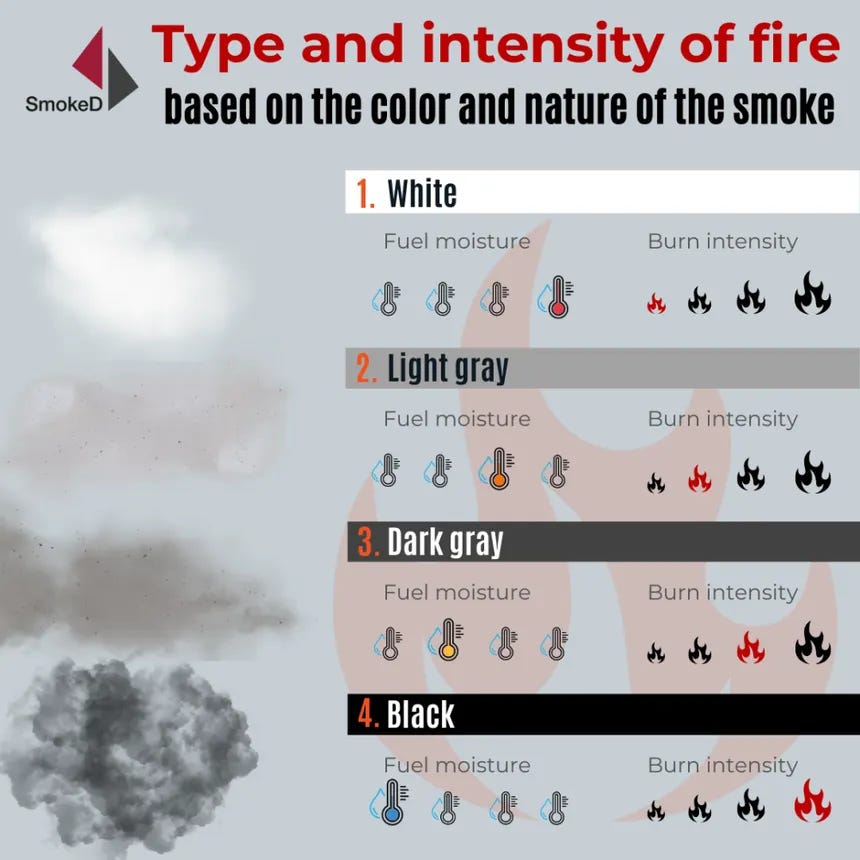
Thick black smoke: fuel, plastic, or chemicals are burning. White or gray smoke: there is moisture, or the fire is starved of oxygen.
Why obsess over these details?
Because if they open the wrong door, they become the ones feeding the fire instead of containing it.
That is systems thinking. Reading hidden patterns from the parts you can observe.
The simplest definition of a system:
Connected parts that keep producing the same pattern.
Your company is a system. Your career is a system. Your marriage is a system.
Walk into one of my restaurants. Customer, menu, register, cook, stove, server. Those are the parts. What connects them is order flow. The customer chooses, the register enters, the kitchen prepares, the server delivers. That is the system running inside a restaurant.
Once you start observing, you have a path to go deeper.
Parts. Connections. Patterns.
If it is that simple, why are most of us so confused about systems?
Three reasons.
1) You Don’t Know Which System You’re In
There are four types of systems and each one has its own path to a solution.
If you don’t know which one you are in, one of two things happens:
You can’t think your way out of the problem. Or you bring the wrong approach to the right system.
Most people’s mistake is the second one. They improvise where a checklist is needed, hire an expert where experiments are needed, and drown in analysis where immediate action is needed.
I’ll break down all four below.
2) The Cobra Effect
In the early 1900s, British officials in Delhi were worried about the growing cobra population.
They created what looked like a reasonable policy: a bounty for every dead cobra.
Simple, right?
Then something very strange happened. There were more cobras in the city than ever before.
Why?
Because people figured out how to game the system. They started breeding cobras. More dead cobras, more money.
A policy designed to reduce cobras increased cobras.
This is called the incentive problem. When you attach a reward to the wrong thing, people optimize the system for the reward and forget what the system was built for.
Humans make systems messy. Every manager who forgets this ends up breeding his own cobras.
3) Delayed Feedback
In some systems, feedback is delayed. You act now, but you can’t see the result for a very long time.
For most of the twentieth century, cigarettes were part of the culture. Movie stars smoked, doctors smoked, soldiers smoked.
The satisfaction arrived in seconds. Relief, pleasure, focus, social bonding.
The damage arrived decades later.
Nobody smoked one cigarette and suddenly got lung cancer. The distance between cause and effect was so long that nobody felt the connection.
I fell into the same trap. I neglected my body for years and nothing happened. Then one day I was staring at 106 kilos and diabetes. The bill arrived years later, but it was being written every single day.
Delayed feedback is the most dangerous kind of system. Because nobody tells you that you are doing it wrong. Until it is too late.
Walk into a grocery store or a coffee shop and ask three questions about what you cannot see:
What are the hidden parts? How are they connected? Which pattern keeps repeating?
The moment you start asking these questions, you start thinking in systems.
Now, the four types.
Clear Systems: The Checklist

In the 80s, Van Halen was one of the biggest rock bands in the world. But the most legendary story about the band wasn’t about the band.
It was about M&M’s.
Their shows were enormous. They had a 400-page contract covering the stage setup, the electrical requirements, the safety protocols. Buried deep in that contract was one small line:
“There will be a bowl of M&M’s backstage. All brown ones removed.”
It sounds like rock star nonsense. It wasn’t.
If the band walked backstage and saw brown M&M’s in the bowl, they instantly knew the venue had not read the contract carefully. And a venue that missed that tiny detail might have missed something dangerous in the stage setup.
By looking at a bowl of candy, they could read the state of the entire system.
That is the benefit of a clear system. Cause and effect are directly observable. Follow the steps, predict the outcome.
If you are cooking from a recipe book, you are in a clear system. Your job here is not to be clever or creative. Your job is to be precise and follow the process.
In the kitchen we call it mise en place. Before service, everything in its place, everything ready, everything on the list. The best cooks are not the most creative ones. They are the ones with the most respect for the prep list.
A surgeon scrubbing in before an operation is not obsessive. He has a clear system. Hands, wrists, forearms, two minutes minimum.
What do you do in a clear system?
You use a checklist.
Watch a brilliant surgeon or an experienced pilot. They all have one. It is not an insult to their expertise. They are simply accepting that they are human and were born to make mistakes.

The moment you find the brown M&M’s in your own bowl, you already know something is broken.
Complicated Systems: The Right Expert
A patient walks into the ER: “My chest hurts.”
Three words. Twenty possible causes. One of them could kill him within the hour.
The symptom is clear. The cause is not.
That is a complicated system.
The only difference between a clear system and a complicated one is the cause-effect relationship. In a complicated system, it is hard to understand. You need analysis or expertise to uncover the connections.
You are buying a house and choosing a mortgage. The answer exists, but it isn’t visible until an expert walks you through it. Fixed or variable? What term? What fits your situation?
Complicated systems are everywhere. Medical diagnosis, financial modeling, tax planning, aircraft maintenance, acquisition due diligence.
All of them require an expert. But not just any expert. The right expert.
When a clot hit my kidney, it took the right specialists to find out the problem was not in the kidney at all. The cause was in my heart and in my blood. Had I gone to the wrong expert, I would have been treating the wrong organ.
A cardiac surgeon doesn’t treat lung cancer.
What do you do in a complicated system?
Slow down. Analyze. Find the right expert.
But there are systems harder than complicated ones.
Complex Systems: Small Experiments
Years ago I opened a restaurant with a friend as a partner.
On paper everything was perfect. He was a chef, I was an entrepreneur. He knew the kitchen, I would grow the business. The parts complemented each other.
Within the first few months, reality showed up. While I was running from morning to night on new ventures, he was going home to play video games. He said nothing to my face and everything behind my back. The partnership ended.
No checklist could have predicted that. No expert could have told me “this man will lose to his ego in six months.”
Because putting two people into a partnership is a complex system.
Complex systems are harder than complicated ones. Here, cause and effect are only visible in hindsight. And hiring experts doesn’t help much either.
Think about it this way: you are rolling out AI across your entire company. You hire consultants, they build a roadmap, they pick the tools. That is a complicated system. Hard, but doable.
Then you ask your people to change how they actually work.
At that moment you graduate from complicated to complex.
Will the change succeed? Nobody knows. The answer only emerges over time.
Every mother and father knows this. You cannot raise a teenager with a standard operating procedure. What worked last week fails this week. Their body is changing, their brain is changing, their priorities are changing.
Not a clear system, because you can’t raise a teenager with a checklist. Not a complicated system, because you can’t hire an expert.
What do you do in a complex system?
You run small experiments and adjust in real time.
All you can do is stay directionally right, not precisely right.
Try. Observe. Correct.
But there is a system where even your experiments won’t work.
Chaotic Systems: Stabilize First
September 1982. Seven people in Chicago died after taking Tylenol capsules laced with cyanide.

Nobody knew how widespread the danger was. Nobody knew which bottles were safe. Nobody knew if more deaths were coming.
That is a chaotic system.
Johnson & Johnson had no time to analyze, consult experts, or walk through a checklist. They warned the public. They pulled 31 million bottles off the shelves.
Their strategy: Stabilize first. Ask later. Understand later.
In a chaotic system, the link between cause and effect isn’t hidden. It’s broken. Information is incomplete and constantly changing. The only move is to act first, stabilize the ground, and ask what happened once the ground stops moving.
If you run a restaurant, you know this. When the power goes out in the middle of Saturday service, you don’t hold a meeting. First you calm the guests, first you think about the walk-in cooler, first you make sure nobody gets hurt. You talk about why it happened on Monday.
The biggest mistake you can make in a chaotic system is analysis paralysis. People want the full picture before they act. But chaos has no interest in teaching anyone anything.
It’s like an earthquake. The moment it hits, there is no pattern to respond to. Move fast and create safety.
Four Systems, Four Protocols
Clear: Cause and effect are obvious. Follow the process. Use a checklist. Don’t improvise.
Complicated: Cause and effect exist but are hidden. Slow down, analyze, find the right expert.
Complex: Cause and effect are only understood in hindsight. Run small experiments, stay adaptable, correct course.
Chaotic: Cause and effect are broken. Act immediately, stabilize, create safety, then understand.
But real life doesn’t come with labels. Nobody walks through your door and says “Congratulations, today you’ll be dealing with a complex problem.”
That is why you need a diagnostic tool.
The DART Framework
D) Deconstruct
Break the problem into its parts. Are the parts stable or constantly shifting? Before you decide anything, see what the system is made of.
A) Analyze
The most important step. One question:
What is the connection between cause and effect?
Obvious: Clear system. Discoverable through analysis: Complicated system. Constantly changing, visible only in hindsight: Complex system. Completely broken: Chaotic system.
This single question tells you which system you are in. Once you know, you know what to do next.
R) Recognize
Have I seen this before? Even if you haven’t seen this exact pattern, have you seen something similar in another system?
The order flow in a restaurant and the workflow in a software company are the same pattern. The ego problem in a partnership and the ego problem in a relationship are the same pattern. Recognizing patterns across systems is one of the most valuable skills you can have.
T) Test
Run the smallest test you can before committing to a full response. And remember, in a chaotic system there is no time to test.
Once you know the nature of the beast, you know how to deal with it.
But the most critical part of systems thinking is still ahead.
The System Is Training You Too
Every system you live inside is quietly training you.
This is the biggest feedback loop most people never see.
The hard part is this: from inside the system, you can’t see which direction it is taking you.
You are sitting in a train at the platform. The train beside you starts to move, and for a moment you genuinely don’t know: is it your train moving, or theirs?

Because from inside the train, the sensation is identical.
But for someone standing on the platform, there is no confusion.
How do you get the platform perspective while you are inside the system?
Three ways: Mentors, data, time.
A mentor is the person on the platform. Outside your world, with no stake in your story. He sees your train from the platform.
Data. Numbers don’t care about your narrative. Data that shows what the system is actually doing is worth more than your belief about what the system is doing. Your weight, your revenue, your hours, how many times you made the same mistake.
Time. The greatest truth teller. Compare yourself to who you were a year ago, a month ago, a week ago.
Mentors, data, time. Any one of them will tell you which direction your train is moving.
The Story You Tell Yourself Is a System Too
Adler called it the life lie.
A story that sounds noble and hides the real purpose of your behavior from yourself.
You say “I’m searching for meaning” when you are avoiding confrontation. You say “I have high standards” when you are afraid of rejection. You say “I’m waiting for the right time” when you never intend to start. You say “That’s just who I am” when you don’t want to pay the price of changing.
The life lie is a system too. It has parts, it has connections, and it keeps producing the same pattern. From inside the train, it feels completely real.
That is why you can’t see the system inside your own head on your own. You have to get to the platform. An honest friend, a hard number, a look back.
Two hospital beds taught me this. The first time I broke down because I neglected my body, the second time because I pushed it too hard. Each time I was telling myself a story, and each time the story was wrong. When the data arrived, the story collapsed.
Ferrari or Toyota?
Conventional business wisdom says you have two options.
Build a Ferrari or build a Toyota. A high-margin luxury product or a high-volume everyday product.
Most of these binary choices are not limits of reality. They are limits of system design.
Look at Apple. They make 350 iPhones every minute. Not every hour. Every minute.
A luxury product at mass-market scale. Something that shouldn’t exist, but does. Because Steve Jobs and Tim Cook spent twenty years building a system the world had never seen before. They refused the binary choice.
It is hard to be consistently better than others.
It is not hard to be consistently better than yourself.
The hardest system to redesign is the one you built inside your own head. The story you accepted about who you are, what you can become, and what limits you place on yourself.
That story is part of your system too.
And like every system, it can be redesigned.
Summary
With every problem, ask first: Which system am I in? In a clear system, use a checklist. In a complicated system, find the right expert. In a complex system, run small experiments. In a chaotic system, stabilize first. Check your incentives: Are you breeding cobras? Account for delayed bills: What you don’t feel today will arrive tomorrow. Get to the platform: Mentors, data, time. And examine the story you tell yourself as a system too.
You can be a Ferrari and a Toyota at the same time.
The world will meet you at the level of your audacity.
-Can