

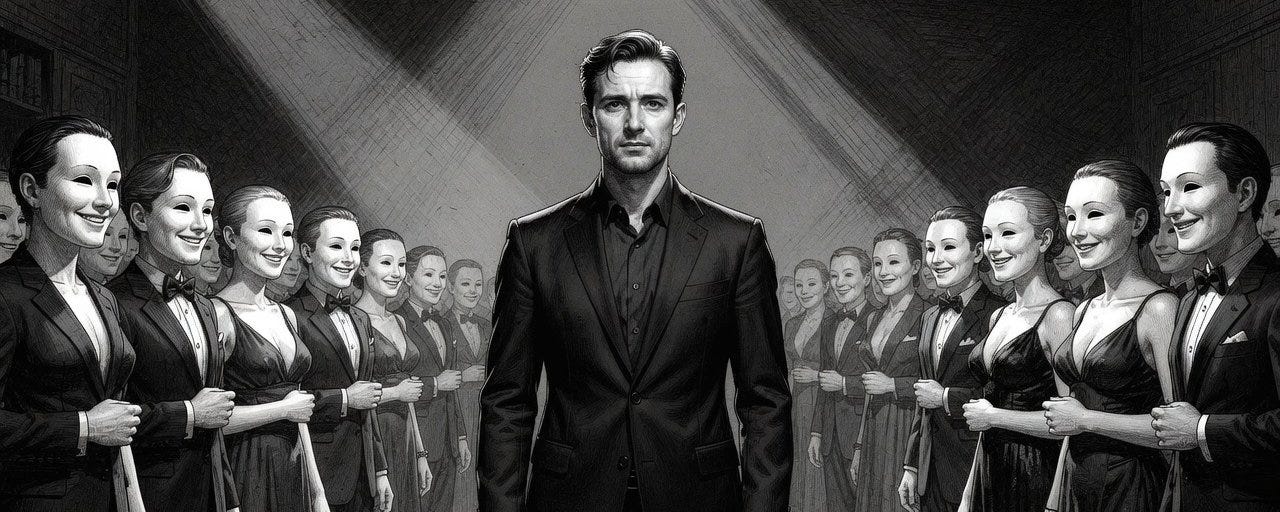
Seduction is about psychology, not looks. And today I am going to tell you everything I know about power, seduction, mastery, and the dark side of human nature, because a person who does not understand these subjects is playing life at a permanent disadvantage.
Power Is Not What You Think It Is
When people hear the word power, they think of muscle. Height, broad shoulders. Money. A connection to someone in a position of power. Status. Designer clothes. A luxury car. Wrong.
Power is a feeling. An emotion. A human need.
At its core, power is understanding yourself and being able to control yourself. Feeling that you have no influence over your children, your spouse, your coworkers, that you cannot move them with your ideas, that you cannot get them to help you with a project, is one of the most miserable feelings a human being can experience.
Absolute power corrupts. But absolute powerlessness corrupts even more.
The feeling of powerlessness makes people passive-aggressive. It pushes them into strange, negative games. It drives them toward manipulation, indirect aggression, sneaky moves. Most people believe they are not chasing power, but the games they play the moment they feel powerless reveal the truth.
Power is feeling that you have some degree of control over the events in your life, the people in it, and your future.
If You Can’t Control Yourself, You Can’t Control Anything
Someone who cannot control himself cannot be powerful. It is that simple. And I lived through this twice, very clearly.
Years ago I opened a restaurant with a friend. The guy was in a rough spot. His family had humiliated him and kicked him out of the house. He was working as a cook at a hotel and was unhappy with his job.
I reached out and offered him a partnership. We opened a beautiful restaurant. While I worked from morning to night on new ventures, instead of taking ownership of the restaurant he went home and played video games. He could not control his laziness or his ego.
He never said anything to my face. He acted like everything was normal, but behind my back he demonized me. He blamed his own laziness on me. I ended the partnership and left the restaurant entirely to him. He could not run it alone and handed it back to me.
Not once in his life could he tell me what he really thought to my face. If he could have controlled himself, reined in his laziness, swallowed his ego and spoken openly with me, he would not have lost a partnership that made him good money, and the possibility of doing business together again.
The second story comes from a different arena, but the dynamic is the same. A girl who had been my friend for years had just broken up with her boyfriend, and over a few months we built a long-distance bond. I had started to fill the emotional void the breakup left behind.
But she was asking me for the things she would normally ask a boyfriend. She was loading the provider role onto me without taking on the responsibilities of a girlfriend. The distance gave her a shield. I started to develop feelings. But when it came time to get closer, she pulled back.
She acted as if the bond she had built never existed. I spoke openly. I told her what I felt and how I saw the situation. But instead of telling the truth, she surrendered to her ego. She could not find the courage to face it. She could not say, “I acted that way out of loneliness, I filled the void with you.”
If she could have controlled herself, she would have either been clear from the start or honest at the end. She did neither. And the moment I recognized that lack of control, I blocked her. She lost a good friend, and maybe a relationship.
Both of them lost for the same reason: they could not control themselves. They could not control their laziness, their egos, their emotional needs, their fear of confrontation. And the things they could not control started to run them.
Power does not start on the outside. It starts on the inside. It starts with being able to rein in your impulses, to be honest, to wait for the right moment. A person who cannot do this is powerless no matter how much muscle he builds or how much money he makes. And he loses.
Everyone Is an Actor, and That’s Not a Bad Thing
When you walk into a room, people judge you within the first three seconds. By how you dress, how you walk, how you speak. Nobody knows what is inside you. Nobody is curious. The first impression comes from appearance.
Is it unfair? Yes.
Is it real? Yes.
You cannot change it. This is how humans work. You cannot see inside the person across from you, but you read their face, their posture, their voice. Everyone does this. You do it too.
So when you step outside, you are playing a role. We all are. You are different at work, different with friends, different around your family. This is not fakeness. It is a survival skill. It is part of being a social animal.
But most people mistake the role they play for their real self. They believe the “professional” version at work, the “happy” version on social media, the “relaxed” version with friends is their true identity. And when they get confused about which one is real, they fall into a crisis.
In earlier ages, people knew this. They put the mask on when they walked out the door and took it off when they came home. They were conscious of the difference between the two. Everyone accepted that the role outside and the real self inside were different things.
Today that distance has disappeared. Because of social media, you are on stage 24/7. You have no place left to take the mask off. And the mask has fused to your face.
The solution is simple: know that you are playing a role out there. There is nothing to be ashamed of. But do not mistake that role for the real you. When you come home, when you are alone, that is you. As long as you do not confuse the two, you are fine.
Friendship Can Be Dangerous in Business
In business, when you need to hire someone, find a partner or an employee, your mind naturally drifts to a friend. Because you know him, you trust him, you feel comfortable.
In friendship, emotions come into play. Those emotions cloud the work. If you want results in business, you have to think practically, not emotionally. Hiring your friend means carrying all the emotional baggage of that relationship into the workplace.
You can even walk up to someone you have never gotten along with and say, “Let’s bury the hatchet. I think you are brilliant. Will you work with me?” The emotional shift on the other side is incredibly powerful. He never expects it, and he becomes extremely motivated to prove he deserves it.
The point is not to distrust your friends in your personal life. The point is understanding that business is a completely different arena from personal relationships.
Sometimes You Need to Conceal Your Intentions
Do not tell everyone everything. That is it.
Your team, your partner, the people beside you... Yes, share your vision. You need to motivate them, you need to walk toward the same goal together. But to the outside? To your competitors? To people you do not know? Revealing every plan you have is stupidity.
Business is a battlefield. Everyone steals everyone’s ideas. While you are still saying “I am going to do this,” the person across from you has already started doing it. Do not put the dish on the table before it is cooked.
Sometimes say the opposite. Say “I am heading in this direction,” then go a completely different way. You call that deception? Call it that. But all is fair in love, war, and business. The ones who survive are the ones who understand this.
A little mystery is a good thing. If people do not know your next move, they get uneasy. An uneasy person does not underestimate you.
Even the “best” people in history did this. Gandhi was peaceful, but he planned his protests strategically. He knew the enemy’s weak point, calculated the public’s reaction, foresaw how the images would play in the media. He was sincere, but he was also a strategist.
Martin Luther King did the same. When the movement hit a dead end, he brought children into the marches. His advisers said, “Have you lost your mind? You are putting children at risk.” But King knew that if the American public saw children being blasted with fire hoses on television, the world would change. And it did.
Being a good person does not mean being a naive person. Thinking strategically is not a bad thing. The point is to never act unconsciously. Make every move deliberately. Sometimes share, sometimes stay silent. But always know what you are doing and why you are doing it.
Everyone Has a Dark Side, Including You
Everyone points at someone else and says “narcissist.” But when they look at themselves?
“Me? No way, I am not like that.” They are lying.
Every human being thinks of himself first. This is biological, not a choice. When you walk into a room, your first thought is “how do people see me.” When you look at a photo, the first thing you search for is your own face. When someone compliments you, it feels good. When they criticize you, it stings. These are the marks of narcissism. And everyone has them.
Yes, some people are far worse. There are people who twist everything to their own benefit, who cannot feel empathy, who constantly demand attention. Those are deep narcissists. But saying “I am nothing like that” only means you have not seen your own dark side.
I had to face mine too. Grandiosity, anger, self-centeredness. The moment I saw them, I could start to control them. I could tell myself, “Stop. Right now you are only thinking about yourself. See the person in front of you.” If I had ignored them, controlling them would have been impossible.
Where Does Narcissism Come From?
Picture a small child. Three or four years old. Yesterday he was the center of the universe. His mother and father devoted every moment to him. Then a sibling arrived, or his parents went back to work, or something else happened. He no longer gets the attention he used to.
The child’s brain interprets this as “they do not love me.” And he is forced to learn to love himself. Inside, he says, “I am actually a good person. The problem is not me.” This is the foundation of self-esteem. This is healthy.
But some children never learn it. The abandoned ones, the abused ones, the unloved ones. When they grow up and someone criticizes them, they have no inner shield to fall back on. Either they explode, shout, blame, attack. Or they come to believe the only way to earn love is to constantly perform, grab attention, create drama. That is how deep narcissism is born.
Use Your Dark Side
Loving yourself is not a bad thing. It is necessary. But as you get older, if you keep that love only for yourself, it rots. You have to turn it outward. You have to transform it into empathy, into seeing others, into giving.
And do not run from your dark side. There is incredible energy in there. When I was young, I was a very angry person. If I had tried to destroy that anger, it would have eaten me alive. Instead I channeled it into things: into work, into writing, into building.
The people who wronged you, who belittled you, who crushed you, who treated you unfairly, can become your greatest fuel. The “I will show you” energy, channeled into the right place, creates miracles.
Your dark side is not your enemy. Know it, accept it, and put it to work.
Seduction Is the Highest Form of Power
You cannot make someone do something by yelling at them. Even if you do, they will hate you. Through fear you get obedience, but they will stab you in the back at the first opportunity.
Now imagine a different scenario. You catch someone’s interest. You listen to them. You make them feel valued. They enjoy spending time with you. And one day, when you ask them for something, they say “sure” without thinking. Because they like you. Because they feel good around you.
That is seduction. And it does not apply only to romantic relationships. In business, in leadership, in friendship, in customer relationships, this is the most powerful way to influence people. Not by force, but by attraction.
The Only Secret of Seduction
Turn off the voice in your head.
When most people meet someone, the voice inside says, “Do they like me? Did I say something stupid? Am I funny enough? Am I good-looking enough?” That inner monologue paralyzes you. You do not even see the person in front of you, because you are actually busy with yourself.
Seductive people do the exact opposite. They shut down their own head and focus on the other person. They listen. They observe. They try to understand what that person wants, what they are missing, what they need.
Why is this so effective? Because nobody does it. In daily life, people do not truly listen to each other. Everyone waits for their turn, thinking about what they will say next. When you show someone genuine interest, when you see them as an individual, that person is mesmerized. Because it is so rare. And what is rare is valuable.
What Repels People?
Moralizing. Nobody on a date, at a business dinner, or in a conversation wants to be lectured. The “you shouldn’t do that, that’s wrong, you don’t know” attitude drives people away. The person across from you is not your student.
Stinginess. And do not think of this only as money. Being stingy with your time, stingy with your energy, stingy with your attention. Picture a man on a first date asking, “If I pay the bill, are we sleeping together?” Do you know what just happened? The man opened his mouth and finished himself with a single sentence. Because that sentence says: “I want a return on the money I am about to spend on you. This is an investment and I expect a payoff.” He sees the woman across from him not as a person but as a transaction. Nothing is more repulsive than that.
Vulnerability Attracts, Insecurity Repels
Understanding the difference between these two is vital.
Why does vulnerability attract? Because being seduced means dropping your defenses, setting your ego aside, letting another person into your world. Why does a puppy charm you? Its vulnerability. That feeling of “it needs protection” brings out qualities you do not normally have.
You carry a wound inside and you need healing, and the person across from you naturally wants to help. That is vulnerability, and it is attractive.
But insecurity is a completely different thing. “I am so consumed with myself, so anxious, that I cannot step outside of my own head.” You smell insecurity, and it makes you insecure too. It makes you feel strange as well. The moment you catch the scent of insecurity on someone, something breaks.
And when people meet someone who appears strong and invincible no matter what, they sense something odd there too. A person with no vulnerability at all can be frightening. Something about them feels wrong.
Find the balance. Be strong, but do not be afraid to show your wound.
Make an Effort, But Don’t Be a Simp
Let’s separate these first, because most men confuse them.
Making an effort and simping are not the same thing. A simp chases the woman, says yes to everything she says, keeps insisting after being rejected, tries to buy attention with money or gestures. And he expects something in return: approval, attention, sex. That is not effort. That is begging.
Real effort is something else entirely. Real effort is the respect you show yourself, and the reflection of that respect onto the person across from you. Dressing well before a date, choosing a nice place, making a plan. You do these things not to impress the woman, but because that is what suits you.
The guy who shows up in jeans and messy hair saying “this is who I am, take it or leave it” is dressing his laziness up as authenticity. It means three months from now he will take that woman completely for granted. Because from the very start, he showed he did not care.
The Real Problem With Young Men
Why do young men struggle with dating? Because they were conditioned to believe everything should be easy and fast.
Internet porn wrecks the brain. Sex looks like something that should be easy and instant. Women are presented as objects that should fit a certain mold. Then a real woman shows up in his life and he has no idea what to do. Because a real woman does not behave like the one on the screen.
You got used to swiping and matching on dating apps. But the real world does not work that way. Winning a person takes time, takes patience, takes the ability to absorb rejection. And most importantly, it takes getting out among people and gaining experience. You cannot learn this skill in front of a screen. The way she crosses her legs, the way she holds her glass, what her eyes are saying while she looks at you... You can only read these there, in the moment.
The women who knew history’s greatest seducers all say the same thing: “He was so relaxed, so sure of himself, that sitting next to him felt like having two martinis.”
Notice, they do not say he wore an expensive watch. They do not say he was muscular. They do not say he was handsome. They say he was relaxed and confident.
That is the target. Being relaxed. Being at peace with yourself. And you cannot fake it. Either you are or you are not. That is why you have to do the inner work first.
Fake Confidence Has a Smell
Fake confidence is bravado. You are playing a part, and the other person knows it. Women especially have been dealing with this for millennia. They can smell it. It shows up not in your words but in your body language, your tone of voice, your micro expressions.
Real confidence comes from real actions and real achievements.
Having confidence at 21 is hard, because what will it rest on? Maybe you are very good-looking, maybe you are good at sports, maybe you dance beautifully. But it has to rest on something real. You need a skill, something that sets you apart.
The best confidence comes from creating things, from reaching your goals, from a track record of wins. And you do not need to be handsome or beautiful to seduce. That is a myth. Some of history’s greatest seducers were not attractive at all.
It is about psychology and how you carry yourself. And how you carry yourself rests on what you can actually do. Not on what you feel or what you say.
Body Language Doesn’t Lie
The vast majority of communication is nonverbal. We evolved for hundreds of thousands of years without language. Our earliest ancestors depended on the group to survive, and their power came from observing other people.
At two years old you had this skill, because your life depended on it. You had to read whether your mother loved you, whether your father was okay, or you could be abandoned. Children are incredibly gifted at reading body language. If you are a fraud, you hate being around children, because they see through you like radar.
But as we grow up, we lose this skill. We focus on words and sink into ourselves.
The problem with words is that people can lie. They can say, “I loved your screenplay.” They can say, “You were magnificent in that film.” They will say anything to please, to flatter, to control. But body language does not lie.
The fake smile: you see it every day but you do not pay attention. In a real smile the whole face comes alive, small wrinkles form at the corners of the eyes. In a fake smile there is tension. Knowing this difference is incredibly valuable in business, in romantic relationships, everywhere.
Tone of voice: you can mask your face to a degree, but never your voice. Even the best actors cannot fully hide the tension in their voice. People who talk fast are usually nervous. Someone who speaks slowly, in a steady tone, radiates trust.
Foot direction: if you are talking to someone at a party and their feet are pointed away from you, they are looking for a chance to escape. If their feet are pointed toward you, they are interested.
So how do you master such a complex language? The answer is clear: if you feel secure in yourself, it naturally flows into your gestures. If you try to monitor every finger, every arm, every eye movement, you will drive yourself insane and look extremely weird. The real work is internal.
Mastery Takes Time, and That’s a Good Thing
Everyone wants a shortcut to becoming something. They want to learn how to manipulate, how to influence people, how to gain power. But nobody sits down and learns to do one thing genuinely well.
If you cannot produce something, if you cannot do one thing well, everything else hangs in the air. You speak beautifully, but there is no work behind it. You charm people, but there are no results. You know strategy, but you cannot build anything concrete. At some point, everyone figures this out.
Every time you repeat something, a pathway forms in your brain. The more you use that pathway, the stronger it gets. This is called deliberate practice. The psychologist Anders Ericsson researched it his whole life and concluded that the idea of innate talent is a lie. People who reach mastery are not more talented. They are people who repeated more, and repeated more deliberately.
For the first 100 hours you are a beginner. At 1,000 hours you can get by. At 5,000 hours you are good. At 10,000 hours you do it without thinking: fingers, reflexes, intuition take over. Ericsson saw this again and again in violinists, chess players, surgeons, athletes. The difference always showed up in the same place: whoever endured more of the boring, repetitive, deliberate work won. Not talent, patience. Not inspiration, repetition.
But in today’s world, people cannot even get past 100 hours. They want everything now. They play guitar for two weeks and say “I have no talent.” They train for three months and say “I am not seeing results.” They run a business for six months and say “it did not work out.” Of course it did not. You have not even started.
Forget About “Passion”
I hate the phrase “find your passion.” Because people understand passion like this: “The moment I sit down I will feel excited, my motivation will be sky-high every day, I will never get bored.” No such thing exists.
Every craft has its boring part. You learn piano: the first six months are finger exercises, scales, silly melodies. You learn to cook: the first year is chopping onions, cleaning, basic techniques. You learn to code: the first months are meaningless exercises, error messages, garbage code. These are boring. Passion will not carry you through them.
What carries you through is connection. There is a pull between you and that craft that you cannot explain. You can tolerate even the boring parts, because not doing that thing bothers you more. Whatever you felt a natural pull toward as a child, or at 18 to 20, that is your path. If your body says “yes” when you play sports, if your mind goes quiet when you write, if something stirs inside you when you hear music, follow that path. Do not analyze it. Feel it.
And do not waste your twenties. Your twenties are the most critical decade of your life. If you build a skill in those years, you harvest the fruit in your thirties. If you spend them on fun, on wandering, on “finding yourself,” you start your thirties from zero.
Learning, Not Salary
At the start of your career, do not pick the job that pays the most. Pick the job that will teach you the most.
You can work next to an entrepreneur in a small shop for a third of the salary. Or you can join a big corporation for three times as much. Choose the low-paying one. Because in that small place, you will learn everything. The fundamentals of the work, the customer, the money, the responsibility. In the big corporation you get lost. Nobody teaches you anything. You sit in your corner.
And from day one, do not try to impress people. This is the biggest mistake. When you enter a new place, the only thing you should do is observe. Who gets along with whom, which skills are valued, what the rules are, what the unwritten rules are. Absorb like a sponge. Close your mouth, open your eyes.
Finally, learn by doing, not by reading. No YouTube video, no book, no course will give you real skill. You have to get your hands dirty. The human brain is designed to learn by doing. It has worked this way for 300,000 years. You cannot change that. Sit down and do.
One Day Everything Can Be Taken From You
In 2023 I weighed 106 kilos. My body fat was 35 percent. I was diabetic. I did not train, did not take care of myself, took my body for granted.
Then, out of nowhere, I had rhabdomyolysis. Protein leaking from my muscles overloaded my kidneys. I was hospitalized. My kidneys were in danger.
106 kilos, diabetes, a sedentary life, and the body finally sent the bill. That was the first warning.
I started training. I lost the weight. I fixed my diet. I changed my life. When I looked in the mirror I saw a different person. Everything was coming together. In 2025 I weighed 76 kilos. My body fat was 9 percent.
But I overdid it.
More, heavier, harder. On deadlifts, on squats, on the heavy lifts, I was constantly doing the Valsalva maneuver. You hold your breath and build pressure so you can move the weight. Everyone does it. It is normal.
It is normal, unless you have a hole in your heart that you thought was closed.
I had something called a PFO. A small opening between the two upper chambers of the heart. It is congenital, and in most people it closes. I assumed mine had closed too. It had not.
I also had APS, antiphospholipid syndrome. A condition that makes the blood clot more easily than normal. I did not know about that either.
A perfect storm. And every day in the gym, I was triggering that storm. When I did the Valsalva, the pressure inside my chest spiked, a clot passed through the PFO I thought was closed, and that clot blocked my kidney. Renal infarction. Blood flow to the kidney stopped. The kidney started to die.
If that clot had not gone to the kidney, where would it have gone? It could have gone to the brain: a stroke. It could have gone to the lungs: death. The kidney was the “lucky” scenario. And without knowing any of this, every time I lifted, I was playing Russian roulette.
The first time, I collapsed because I did not take care of myself. The second time, I collapsed because I took care of myself and went too far. At both extremes, the same problem: lack of control. Neglecting my body was lack of control, and punishing my body was lack of control too.
The Aftermath
Quit heavy training. No Valsalva until heart surgery. No lifting.
The thing I started in order to change my life became the thing that endangered my life. Training was no longer just a physical activity for me. It was the thing that rescued me from diabetes, from 106 kilos, from my old self. It had become part of my identity. And they took that identity away from me.
Then the blood thinners started. Every day, morning and evening. Forget a dose: risk. Bump into something: risk. For the rest of your life.
You cannot understand being on lifelong medication until you live it. You are in your thirties, you have just pulled yourself together, you are living your best form. But every morning as you swallow that pill, your body tells you: “You are not healthy. Do not forget it.” The same reminder, every single day.
The Comeback
But I came back again. After starting the blood thinners, I stepped carefully back into training. Not like before. No ego lifts. No chasing PRs. I listen to my body. I know my limits.
And that is what taught me, in my own flesh, the very thing I wrote at the top of this article.
Killing yourself in the gym is not strength. Obeying everything your ego tells you is not strength. Neglecting my body at 106 kilos was weakness, and tearing myself apart once I started training was also weakness. Both were lack of control. Both were different faces of the same ego.
Knowing your limits and doing your best within them: that is real power. It took two hospital stays for me to understand it.
The Real Lesson
If you are healthy right now, if you can run, if you can lift, if you can get out of bed in the morning without pain, know how enormous that is.
Do not wait for your muscles to break down to know it. Do not wait for a clot to hit your kidney. Do not wait to hear the sentence “it could have gone to your brain” from a doctor.
I was warned twice. The first time I listened, but I listened wrong: I swung from one extreme to the other. The second time I learned balance. Control does not live in any form of excess. Not in neglect, not in overdoing. Right in the middle.
The things you have, that healthy body, those pain-free mornings, the freedom to move however you want, can be taken from you in seconds. Do not take today for granted.
I See Hope in Young People
My journey of studying human nature made me more loving toward people, but not more optimistic.
Technology, phones, television, the internet, crypto, artificial intelligence... It tends to bend, darken, and destroy everything beautiful or interesting. This worries me about the future.
But I see hope in young people. They are growing up in an unhealthy world, and at some point they will rebel. They will say, “I am sick of this virtual world. I want something real.” That spirit of rebellion gives me hope.
Final Words
Do not take what you have for granted. Walking, swimming, tying your shoes, sitting in a park reading a book. These can be taken from you in an instant. And then, only then, will you understand how precious they were.
But you can understand it before you ever reach that point.
Do not run from your dark side. Know it, accept it, and use it productively. Do not stay naive about power games, but do not become their slave either. Learn the art of seduction, but as an outward practice, by truly seeing the person in front of you. Master something, because real confidence comes from real ability.
And do not fall for the lie that everything should be easy and fast. Everything valuable takes time. That is how the human brain works. The sooner you accept this truth, the sooner life starts working in your favor.
-Can