


Most of us learned the hierarchy of needs from Maslow. Psychology books, university lecture notes, social media posts, always the Maslow pyramid. That famous five-layer triangle.
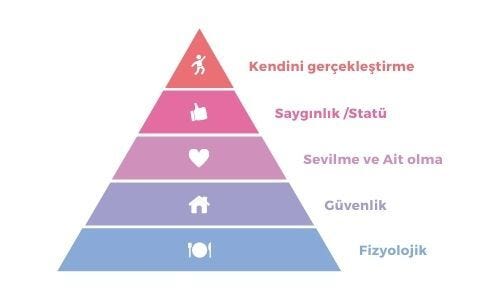
Maslow’s idea was simple: you can’t move to the upper levels without handling the lower ones first. A hungry man doesn’t think about self-actualization, he feeds himself first. First food, then safety, then belonging and love, then esteem and status, and finally self-actualization.
Sounds logical, right? It does. But there’s a problem here. The Maslow pyramid is popular. But Maslow’s teacher, Alfred Adler, is far less known.
While Maslow was doing research at Columbia University, he became Adler’s student directly. After Adler emigrated from Europe to America in the 1930s, Maslow attended his seminars, worked with him, and was shaped by him.
In his founding 1943 paper, Maslow openly wrote that his theory was “fused with the dynamicism of Freud and Adler.” And while explaining the esteem layer of the pyramid, he adds that these needs were emphasized by Adler and his followers and neglected by Freud and the psychoanalysts.
So the Maslow pyramid is actually a popularized version of Adlerian thought. The teacher is Adler. Maslow is the student who packed his teacher’s ideas into a visual, digestible pyramid and spread it across America, and from there to the whole world.
So why do we know Maslow and not Adler? The answer isn’t intellectual, it’s cultural. Maslow got lucky with timing. Post-war America had a positive psychology wind blowing, a visual pyramid was memorable, and the management and marketing world fell in love with it. Adler was quiet, deep, European, and worked with concepts that are harder to market: contribution, courage, social feeling. The market loved Maslow. Adler stayed in the library.
Adler’s Tree of Life
Adler thought of a human being not as a pyramid but as a tree.
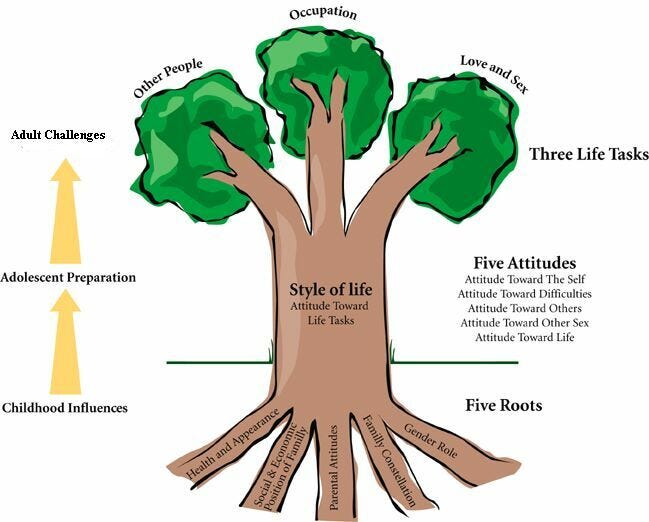
This one image summarizes all of Adlerian psychology in a single frame.
The roots: childhood influences.
Health
The family’s social and economic position
Parental attitudes
Family structure
Gender role
These are the soil you didn’t choose, the things that were already there when you were born. But these roots don’t determine your fate, they only prepare your ground. Different trees can grow from the same roots. How you grow depends less on the roots and more on the meaning you assign to them.
The trunk: the style of life.
The formula you invented on your own at age 4 or 5. “I am this. Life is that. Therefore I must do this.” This formula sits underneath all your behavior. Adler calls it the “style of life.” The trunk is what connects the roots to the leaves. It is your way of looking at the world.
The branches: the three life tasks.
The three big branches the tree sends upward:
Other People (friendship, social bond)
Occupation (work, production, contribution)
Love and Sexuality (intimate relationship)
These are the three arenas where life tests you. On a healthy tree, all three branches are lush. If one branch is dry, the tree grows crooked.
The leaves: the five attitudes.
How you handle these three tasks is read through five attitudes:
Your attitude toward yourself
Your attitude toward difficulties
Your attitude toward others
Your attitude toward the opposite sex
Your attitude toward life
Leaves grow on branches. Your attitudes grow out of your tasks.
This tree metaphor is more accurate than the Maslow pyramid. Because the pyramid is hierarchical and mechanical. Research has shown that the rigid version of the pyramid doesn’t quite fit real life. Tay & Diener (2011).
Real life doesn’t work that way. A person’s work life, friendships, and love grow at the same time. All three feed from the same roots and pass through the same trunk. Neglect one and the others suffer. The tree is one living organism. The pyramid is layers stacked on top of each other.
Anyone who dives a little into the Adlerian literature will notice that some books say “three life tasks” while others say “five life tasks.” There’s confusion.
Here’s the truth: Adler himself only ever said three. In his own text he says: “There is a task in life that no individual can escape. For clarity, I have divided it into three parts: the problems of behavior toward others, the problems of occupation, and the problems of love.”
So three tasks: work, friendship, love. He said nothing else.
After Adler, his students added two more. In 1966, two major followers of Adler, Harold Mosak and Rudolf Dreikurs, said “there are two more themes touched on in Adler’s writings but never fully developed” and added two more tasks to the list.
The relationship with the self, and spirituality. The literature calls this the “Adlerian/Mosak life tasks,” and most modern Adlerian therapists use this five-task version.
Academically it’s still debated. In the 2000s some Adlerians objected: these two tasks Mosak added are not Adler’s original idea, and Adler’s writings don’t actually support the addition. So the question is still open.
So Which Side Am I On?
Did these two tasks really need to be added?
I don’t think so. I think Mosak and Dreikurs tried to graft two unnecessary branches onto their teacher’s tree.
Let me explain why.
First: your attitude toward yourself is not a separate task, it’s a leaf.
Look at the tree again. Adler didn’t draw “relationship with the self” as a separate branch. Because your attitude toward yourself isn’t something floating in the air independent of the three tasks. It’s a leaf that grows out of how you handle the three tasks.
When you say “my relationship with myself is bad,” you’re actually pulling a self-evaluation out of the way you handle the work task, the friendship task, and the love task. Your attitude toward yourself is the product of the three tasks, not a separate task.
Let me make it concrete: telling someone who doesn’t love themselves to “go love yourself” accomplishes nothing. But when that person starts producing something at work, genuinely contributing to a friend, loving someone, their attitude toward themselves changes on its own.
Because self-respect is a byproduct of giving. That’s why the “love yourself” task is wrong. The right version: do your three tasks, and self-respect arrives on its own.
Second: spirituality is not a separate task, it’s another name for belonging.
This is where it gets deeper. Mosak’s added “spirituality task” claims that a human has a relationship with the universe, with existence, with meaning, and that this is a separate task. I disagree. I think the human search for meaning is the voice of a belonging deficit coming out of a different opening.
Think about it: when does a person ask “what is the meaning of life?” When they’re fulfilled, or when there’s an emptiness inside?
In the emptiness.
When a person properly fulfills the work task, the friendship task, and the love task, meaning they feel belonging because they contribute, the question “what’s the meaning?” dissolves on its own. Because life is already meaningful. Meaning is not something you ask, it’s something you live.
What we call the search for meaning is, most of the time, the philosophical wrapping a task-avoider invents to fill their inner emptiness. The sentence “I’m searching for the deep meaning of life” is the more marketable version of the sentence “I feel empty because I ran from my three tasks, and I’m ennobling that emptiness with spiritual packaging.”
The Adlerian formula: belonging = contribution. Meaning = belonging. Solve contribution and belonging comes. Once belonging comes, meaning is already there. There’s no need to add “spirituality” as a separate task, because when the other three tasks are done properly, the thing called spirituality exists by itself.
Third: the three tasks are structural, the other two are optional.
Work, friendship, love: escaping these is impossible. No matter how much you say:
“I don’t work,” life forces you to work one way or another (at minimum, to support yourself). “I don’t need anyone,” you still need to socialize. “I don’t do love,” you were built to love and be loved.
These three are the structural conditions of your biological and social existence.
But you can technically escape the “spirituality task.” An atheist can go through an entire life without ever touching spirituality and still do excellent work, build wonderful friendships, live a deep love. And be happy. So spirituality is not inevitable, it’s optional. And something that isn’t inevitable can’t be a structural task.
The same goes for “the relationship with the self.” You can live a happy life fulfilling your three tasks without spending a single second thinking about your relationship with yourself. Millions of people in history lived exactly like that, especially before modernity. The concept of a “relationship with the self” is, most of the time, the product of excessive introspection, therapy-speak saturation, and modern narcissism.
Conclusion:
Original Adler = three tasks. The two things Mosak added already exist inside Adler’s structure, just not as branches, but in other forms. The relationship with the self = a leaf (the result of the three tasks). Spirituality = the soil (another name for the belonging you automatically feel when the three tasks are done right).
In this essay I’ll stay loyal to Adler and go with the three. Because grafting unnecessary branches doesn’t strengthen a tree, it only ruins its balance.
The Real Difference Between Maslow and Adler
Now back to Maslow. Because the real difference between Adler and Maslow lies in the choice of words.
The Maslow pyramid tells you: "You have needs. Meet the lower ones first, then you move up to the higher needs." Adler says: "You don't just have needs. You have tasks. Life handed you these tasks. If you don't do them, the branches of your tree dry up."

Do you see the difference? A need is passive. "I require it; if someone provides it, I'll take it." A task is active. "I have to do it, and if I don't, I pay the price."
Maslow says “you have a need to belong.” Adler says “belonging is your task, and to belong you must give.” Maslow says “you have a need for esteem.” Adler says “to earn respect you must put a contribution into the world.” Maslow says “you have a need for self-actualization.” Adler says “if you want to actualize yourself, you must do these three tasks (work, friendship, love), there is no other way.”
Adler is harsher. He caresses less and loads more responsibility. And precisely for that reason, his ideas are more transformative than Maslow’s.
Why Exactly These Three Tasks?
We live on a planet. We need food, we need shelter, we need to survive. No one can do everything alone. If we form a community, we can build factories together and produce big cars. One person builds the car, another uses that car to bring bananas from where bananas don’t grow. A third sells those bananas at the grocer, a fourth supplies the grocer’s electricity.
Between waking up and finishing breakfast, you pass through the labor of hundreds of people. The farmer, the driver, the baker, the market worker, the plumber. When we live together, everyone becomes useful, everyone completes what the others lack.
You too have to add a link to this chain. Because if you break the balance between taking and giving, the herd has to carry you on its back. So we must work, produce, put a contribution into the world. The work task.
We live inside a society. We have neighbors, friends, the shopkeepers we know. A human isn’t born alone on an island. Even at the moment of your birth, someone is there to receive you: your mother, a midwife, a doctor. When you get sick, someone brings you soup. When you move, someone helps. When you have a problem, someone listens.
And you do the reverse: you go to a friend’s wedding, you lend a shoulder at a neighbor’s funeral, you become a reference when an acquaintance is job hunting. If this mutual exchange gets cut, a person turns into a ghost walking down the street. Physically present in the crowd, but attached to nothing. So we must bond with people and belong somewhere. The friendship task.
We exist as men and women. This isn’t just a “continue the species” matter. It’s something deeper. Knowing one person up close, letting one person know you up close, two people becoming partners in each other’s good.
At 60, while you drink tea on the balcony, someone will be sitting across from you. When you succeed, the most sincere “well done” will come from that person. When you make a mistake, the one who criticizes you hardest and still stands by you will be that person. No other relationship in life provides this. Not parents (they leave earlier), not friends (they stay at a certain distance), not children (they leave for lives of their own).
Only a spouse, only someone who chose you as a partner and whom you chose as a partner, can fill that space. So an intimate relationship, the task of loving and being loved, is also inescapable. The love task.
So these three tasks are not things you “prefer.” They are the structural condition of your existence. Life doesn’t ask you. It says “you will do these three things, or you will pay the price.”
Most People Run From This Exam
The majority of people are running from at least one of these three tasks. Some from two, some from all three. They put the paper in front of them, look at the exam, say “I can’t do this,” and hand it in blank. Then they blame the unfairness of the exam for the blank paper.
Adler gave this escape a name: the useless side of life. Life has two sides, he says. The useful side: you work, you produce, you build friendships, you give love, you add something to the world. The useless side: you manufacture excuses, you run, you produce symptoms, you burn your life on sentences that start with “actually, I...”
Adler’s observation that shook me the most:
Depression, anxiety, chronic unhappiness, addiction... these appear because you ran from the task. Not the other way around. “I’m depressed, that’s why I can’t work, that’s why I can’t bond with people, that’s why I can’t love.”
Adler flips this logic. He says: you ache inside because you ran from your task, and you call that ache depression. The illness is not the cause. The cause is the escape itself. The illness is the excuse for the escape. The cover story your subconscious manufactures so you’re allowed to keep running from the task.
I know it sounds harsh. But that’s the Adlerian view. It doesn’t caress you, it tells you the truth. And that harshness is actually a gift, because the person who says “I’m sick, let’s wait for it to pass” waits forever. The person who says “I’m running from my task, I need to go back” can finally do something.
In this essay we’ll open up the three tasks one by one. In each, we’ll look at three things:
What excuses do people manufacture to run from this task? How do we spot it in the neighborhood, at the office, among our own acquaintances? And what does it take to stop running? How do we move from a task-avoiding mind to a task-doing mind?
Let’s begin.
First, Understand Why the Tasks Exist
Adler, unlike Freud, didn’t see the human being as a bundle of instincts. Humans live by meaning. And that meaning is not something you find alone; it forms through contribution.
Social feeling (Gemeinschaftsgefühl). The capacity to see with the eyes of another, hear with the ears of another, feel with the heart of another. Empathy, in short. When this capacity is weak, the person is forced to orbit themselves. When the center of life is “me,” life becomes narrow and neurotic.
Courage (Mut). The ability to act in your flawed, incomplete, inadequate state. Most people say they’ll start “when they’re ready.” Adler calls this the if-only fiction. The person waiting for perfect timing is withdrawing from their own life.
Style of life (Lebensstil). The world-interpreting formula you invented on your own at age 4 or 5. “I am this, life is that, therefore I must do this.” All your behavior flows consistently from this formula, as long as you don’t decide to change it.
The task-avoider escapes with two tools. Producing private logic: excuses no one else validates, meaningful only inside their own head. And crossing to the useless side of life: symptoms, avoidance, taking refuge in fantasy.
Now let’s go task by task.
1. The Work Task: The “I Haven’t Found My Passion” Lie
The work task is not just earning money. For Adler, work is your answer to the question of what contribution you offer the world. The cook cooks, the engineer builds bridges, the teacher teaches. Everyone makes someone else’s life easier from some angle. Fulfilling the work task means positioning your own existence as a service to the world.
What does the person running from this task do? They line up excuses.
The most common work excuses
“I haven’t found my passion.”
The passion excuse is the modern era’s favorite escape formula. This sentence, recycled from a Steve Jobs speech, legitimizes millions of people doing nothing. Real passion doesn’t come before action, it comes after it. As you master a craft, the craft turns into passion. The person waiting for passion waits forever.
“The boss / the system / the economy is bad.”
If a person attributes their failure to external factors, they’ve externalized their locus of control. Instead of competing in the real arena, they stay in an imaginary one. “If the system were fair, I’d already be the best.” The pleasure of an imaginary victory is cheaper than the exhaustion of a real fight. That’s why “the economy is bad, look who’s in power, you can’t get a job without connections” excuses are pure escape mechanisms.
“I don’t want an ordinary life.”
In 99% of cases this sentence means “I don’t want to face ordinary difficulties.” The claim of being extraordinary is the noble costume of failing to meet the requirements of the ordinary.
Eternal student syndrome.
The person who’s 30 and still says “I’m developing myself,” hopping from course to course, book to book, producing nothing. Adler had a name for this behavior: the hesitating attitude. Always preparing, never acting. Because action is flawed, while preparation can be perfect. Preparation is the imaginary substitute for action.
“This job isn’t for me.” (every month)
Job-hopping addiction. Every new job brings excitement for the first three months, then disappointment. Because the problem isn’t the job, it’s the person’s way of relating to work. They keep hunting for a better place, because staying means sitting with the difficulties of the current one. When identity is built on not working (”I’m an unemployed person”), the first months of a new job register as an identity threat, and the mind invents excuses to avoid the work.
Work avoidance as anti-system posturing.
Underneath the “I won’t serve capitalism,” “I won’t do 9-to-5 slavery” talk there usually lies a non-producer’s attempt to turn not producing into an ideology. There is such a thing as a real critic of the system, and that person produces. And there is the person hiding their escape in the costume of critique. Only one thing separates the two: output. Is something actually being produced or not?
How to spot it in society
People who, when talking about their profession, only talk about external obstacles and can’t talk about their own contribution.
People whose main occupation is consuming motivational content. Consumption has replaced production.
People who make plans but never execute them. A plan without execution is armor.
People who’ve been saying “one day I’ll...” in the same tone for years.
X profiles with “idea man / thinker / visionary / entrepreneur” in the bio and no concrete output.
The owners of the sentence “I’m actually very talented, but...” That “but” is the joint carrying the person’s entire life.
To fulfill the work task, there is only one question:
“Did the work I did today make someone else’s life one millimeter easier?”
This question is a scale. Not passion, career, status, or salary. Contribution. Adler says a person feels they belong when they contribute. Because belonging is a feeling obtained not by taking but by giving.
If reading this far made you uncomfortable, write these down:
Stop searching for the perfect job. Ask what contribution you can make, to whom, in the environment you’re in right now.
Stop waiting for passion. Grind out 1000 hours at a craft. Passion is the byproduct of mastery. On mastery, I left Ericsson’s book Peak below; it can help you a lot here.
Delete “I’m preparing” from your vocabulary. Waiting to be ready is a lie you tell yourself and everyone around you so you never have to act.
List your complaints. Do you attribute all of them to external factors? That’s a diagnosis. The length of the list equals the depth of the escape.

If you want to master a craft, read it.
2. The Friendship and Social Bond Task: The Source of Fake Belonging
The human is a herd animal. But a human only belongs to the herd they contribute to. Merely being included in a group doesn’t grant belonging. Giving something to that group does.
The person running from this task is internally lonely. And to mask that loneliness, they take refuge in the products of the fake belonging industry.
The excuses for avoiding bonds
“People are fake / shallow / self-interested.”
This sentence is an escape formula. “Since that’s how people are, I won’t bond either.” Misanthropy is, most of the time, the noble costume of wounded narcissism. The one avoiding people is usually the one afraid of being rejected by people.
“I’m antisocial, that’s why I’m alone, and it’s fine.”
Introversion is a real temperament dimension. But when “antisociality” is claimed as an identity, avoidance gets identity-fied. The sentence “that’s just how I am” is, in Adlerian terms, the formula for resigning from the responsibility to change.
“I love being alone.”
Often true. Because solitude is less risky than facing the imperfection that bonding brings. The pleasure of solitude is, in most cases, the quiet comfort of discouragement.
“Nobody understands me.”
When a person turns being misunderstood into an identity, they don’t want to be understood. Because being understood requires opening up, being vulnerable, being open to criticism. Staying misunderstood is safe.
Why is fake belonging inevitable?
Belonging is born from contribution. You cannot belong where you don’t give. You can’t even feel belonging where you can’t give.
This single sentence explains modernity’s loneliness epidemic. When a person can’t fulfill the bond task, they belong nowhere internally. But the human soul cannot stand belonging nowhere. So it has to manufacture fake belonging. It has to live the illusion of belonging without contributing.
This is one of modernity’s biggest industries: selling free belonging to people whose bonding capacity has atrophied.
The forms of fake belonging
Parasocial relationships. The streamer, podcaster, influencer you follow on YouTube feels like your “friend.” You know their lives, you watch their content, you feel a bond. But the relationship is one-way. They don’t know you. Your feeling of belonging isn’t real, it’s a simulation. You are one among a million followers.
Shared-hatred communities. Incel forums, radical feminist communities, groups built around a designated enemy. Here belonging is built on hating someone together. No production, just shared resentment. This too delivers a kind of belonging feeling, but the members must keep feeding on hatred, because they can’t produce a positive bond. If the group they hate disappeared, these communities couldn’t survive a single day.
Digital mob psychology. Joining a pile-on on X. In that 24-hour collective outrage burst, the person feels they belong. The next day they’re alone again. Tomorrow a new target is needed. This belonging works like a drug that demands an ever-higher dose.
MLM and cult-like groups. Lonely people make up most of the traffic flowing into these structures. Because there’s “family” talk there, fake warmth, and the feeling that together you all share a “higher truth.” These structures monetize the pain of people who can’t bond.
Why doesn’t fake belonging satisfy?
Because Adler’s formula doesn’t change. Belonging is born from contribution. Fake belonging tries to take without giving anything. But the human soul senses it. That’s why members of fake belonging structures constantly need a bigger dose. More content, more pile-ons, more us-versus-them conflict. Because real belonging doesn’t flow through that channel.
The forms of real belonging
Neighborhood bonds. Knowing the people in your building by name. Your regular coffee guy asking “the usual?” The pharmacist knowing your medication by heart. These look small, but they produce structural belonging.
Because there’s a mutual relationship where you show up again and again and contribute (you’re a customer to the shopkeeper, you greet the neighbor, you take the trash out on time). None of it is glamorous, none of it is exciting, but without these boring bonds a person feels like a ghost. What makes the modern city dweller lonely is not a lack of luxury, it’s the loss of the neighborhood.
Real contribution inside the family. Living side by side with family doesn’t bring automatic belonging. You have to contribute to the family too. Carrying your mother’s groceries, listening to your father’s troubles, sitting with your sibling while they study for an exam, making time for your kid’s homework.
The family bond is not just blood, it’s the sum of accumulated kindnesses. A family you sit inside of but add nothing to gives no belonging. It’s just a shared living space. Most people’s family loneliness comes from exactly here: they sit in the same house, but no one adds anything to anyone.
Groups gathered around a shared purpose. A sports club, a book club, a hiking group, a chess community, the volunteers of an association, the congregation of a mosque, church, or synagogue. These groups differ from fake belonging structures because there is a shared positive purpose.
You’re running toward something together, not against something. No enemy, just a goal. You join, you show up, you carry things back and forth, and over time the feeling of “I’m one of the people here” settles in on its own.
Sports fandom. Going to the stadium for your team, wearing the jersey with pride, taking your kid to the match, keeping the team’s memories alive. Careful: supporting your own team, not cursing the rival. Do you live off your team winning, or off the rival losing? The first feeds you, the second gnaws at you.
Political or ideological commitment grounded in real values. First you got to know yourself. You discovered your values. Then you found a movement that defends those values. You went, produced ideas, handed out flyers, spoke up when it was needed. Your belonging is an extension of your own thinking, not an imported identity. The key question here: did you choose the movement, or does the movement do your thinking for you? If it’s a position you arrived at from within yourself, it’s real belonging. If it’s a ready-made package you grabbed, it’s fake belonging.
One-on-one deep friendships. Three to five people. The number doesn’t matter. What matters is that you genuinely exist in their lives: you go to their weddings, you show up at the hospital, you rejoice at their wins, you listen to their failures. And they exist in your life the same way. In these relationships the feeling of “us” is lived without ever being spoken. Because it’s already there. Three real friends can replace a million followers; the reverse is impossible.
How to spot it in society
People who haven’t had a real friend in years but constantly claim to belong to a “community.”
People who call the accounts they follow on social media their “family” but go days without a face-to-face conversation with a single human.
People who keep a curated collection of commonly hated figures on social media.
People who have replaced the “I” with an ideological identity and have no personality of their own left.
People who constantly join new communities and dramatically break with the old ones. That’s the natural cycle of fake belonging: at first it feels like salvation, then it collapses.
Social circles that can’t come together without a shared enemy.
There is no bond without giving. If reading this far made you uncomfortable, write these down:
Before building a bond, ask the contribution question. “What can I give this person?” Knowledge, listening, appreciation, concrete help.
Stop mistaking parasocial relationships for real ones. Watching is not bonding. Consumption is not contribution.
Stop searching for a shared enemy in order to belong. Choosing community through negative identity (who you are not) is a symptom of inner emptiness.
Start small. A hello to the coffee guy in your neighborhood, two sentences with your neighbor, a message to an old friend. The library of belonging is built page by page, not all at once.
3. The Love Task: The Geography of Incels, Femcels, and the Forever-Preparing
Love is a task for two. It’s not an equation you can solve alone. It’s a cooperation in which two equal people commit their egos to each other’s good.
The love task sits in a different place from the other two. Because it demands the highest level of social feeling. In the work task you contribute to society, but you can do it from a distance. In love you have to tear the distance down completely and take another consciousness seriously. That takes courage.
And that’s exactly why it’s the most avoided task.
The excuses for running from the love task
Incel logic: “My genes are bad / women want tall guys / my facial structure is inadequate.”
Incel ideology is the most perfect excuse system for escaping the love task. Because it fully absolves the person of responsibility. “My genetics, my height, my jaw are inadequate, therefore I can’t even try.” This is the exact corner of the useless side of life. No action, only theory. No risk of rejection, because rejection is accepted in advance. By framing his own pain as structural fate, the person escapes the vulnerability of trying.
The feeling of inadequacy is universal; everyone feels it. The question is what you do with it. The incel is the person who has turned the feeling of inadequacy into an identity. Because when inadequacy becomes identity, you gain an exemption from action.
The hostility toward women in incel discourse is mostly the externalization of anger at his own inner discouragement. The logic of “they’re guilty because I couldn’t try.”
Femcel logic: the “ban men” and “all men are trash” discourse.
The other face of the same mold. “All men are like this, therefore I won’t bond.” In the generalization, the “I” is placed in the position of a neutral observer, while the person is performing the exact same avoidance behavior as the incels. Seeing the love task and leaving the table with an excuse.
The only difference is visibility.
The incel can’t have sex with a normal woman whenever he wants; that fact holds up a merciless mirror and slams his failure in his face every day. The femcel, thanks in part to today’s attention economy, can open a dating app whenever she wants and find someone. The attention is always there, the door is always open. So the femcel tells herself “I’m not an incel, look, I can find a man whenever I want” and never sees her own condition. She blames men’s inability to bond.
But this is where the Adlerian view rips the mask off. The real problem of the incel and the femcel alike is not the inability to have sex. The real problem is the inability to have a relationship where they can bond. Running from the love task.
Sex is easy. Especially for a woman: in the attention economy, demand is always there. Bonding is hard. Bonding requires being vulnerable, being seen, being taken seriously, committing to another’s good. The love task is a task for two, an equation that can’t be solved alone, because the real matter is not “getting into bed” but “binding two consciousnesses to each other’s good.”
That’s why the incel and the femcel are two faces of the same illness: both hide their escape by confusing sex with bonding. The incel says “I can’t have sex, so I must be unable to bond.” The femcel says “I can have sex, so I have no bonding problem, the problem is men.” Both are wrong. Because both are running from the real matter of the love task.
The femcel’s only advantage over the incel is having the external conditions to mask the escape. The diagnosis comes later, but the illness is the same.
“If the right person comes along...”
Passive waiting. Life doesn’t deliver the right person to you. You become someone capable of recognizing the right person, you go through experience, and you build it together. The “right person” mythology is a tool for postponing action forever.
“I’ll be ready for a relationship once my wounds heal.”
The peak of therapy-speak misuse. Wounds heal only inside relationship, inside bond, by trying and being renewed. The “first I’ll fully heal, then I’ll date” script postpones the love task forever. No one ever fully heals. Everyone lives as someone in the process of healing.
“I’m focusing on my career.”
Sometimes true. Most of the time it’s the professional costume of escaping the love task. Because the work task is done alone; the love task takes two. Using the work task as an excuse to neglect the love task is preferring the easy over the hard.
The endless casual dating / Tinder loop.
Constantly consuming “closeness” without ever truly bonding with anyone. Hypersexuality is also a form of escape from the love task. By reducing intimacy to performance, you dodge intimacy’s real risk (being seen, being taken seriously, committing to someone’s good).
The avoidant attachment identity.
Identifying an attachment pattern (”I attach avoidantly”) is valuable. But claiming it like an identity means “no need to change.” Being avoidant is a diagnosis, not a destiny.
Attachment Styles Are Real, But Your Mom Isn’t the Culprit. You Are. A friend of mine wrote a sharp piece tearing attachment theory apart and comparing it to astrology. (Attachment Styles Theory Is Retarded) The determinism critique is strong. Pop psychology has turned attachment into...
The incel case is almost a perfect specimen for Adlerian analysis. Because every Adlerian concept is visible in plain sight.
Inferiority complex. Seeing himself at the bottom of the male hierarchy.
Failed compensation. Because the inadequacy can’t be channeled to the useful side (sports, career, social skill), it slides to the useless side.
Superiority complex. The feeling of having “swallowed the blackpill and seen the truth.” Unable to compensate for the inadequacy in the real arena, he takes refuge in an imaginary superiority: “I know the truth, the normies are deceived.”
Private logic. The entire terminology of “looksmaxxing,” “heightpilled,” “framecel” produces a reality the outside world doesn’t validate, shared only on the inside.
Fake belonging. Incel forums are fake communities built on shared complaint. Join, contribute nothing, just post your complaint, feel like you “belong.”
Avoidance. Approaching a real woman, risking a real rejection: this is never attempted. Because the attempt carries the risk of falsifying the theory.
The most critical point here: incel ideology is a package of escape not just from women but from the useful side of life altogether. It legitimizes not exercising, not building social skills, not building a career. Because if “everything is height and bone structure,” then doing nothing is rational. The ideology is the mathematical proof of inaction.
Stop Living to Be Chosen. Start Being a Man. Drop the approval addiction. Discipline your desire. Move to the choosing side. Build a life. The man who wants to be chosen hands his power to the other side. Many men, without realizing it, build their entire lives around a single goal:...
The way out is rejecting the ideology and starting the action. Exercise, socialize, face your own wounds in therapy, take the risk. Without courage the love task cannot be fulfilled. Courage is the ability to step into the world in your flawed state.
How to spot it in society
People who’ve been running the “dating is totally rigged” line in the same tone for years.
People who have a theoretical explanation for every potential relationship that ended before it began. Their explanations keep producing theory, never life.
People who set their own share of responsibility in their romantic lives at zero and dump all of it on the opposite sex.
People who analyze love but don’t live it.
People who’ve been saying “I’m working on myself, once I’m ready...” for 5 years.
People who talk about romantic attempts like a “strategic game,” never in touch with their own feelings.
People who, after every ended relationship, rationalize with “I didn’t really want it anyway.”
If reading this made you uncomfortable, note these down:
Look for your own share of responsibility. In everything that happens in your romantic life, what part is yours? Running from this question is the escape from the task itself.
Treat rejection not as an insult to your personality but as part of the process. Being rejected is normal. The person who never gets rejected isn’t trying.
Less theory about love, more action. Instead of swiping left and right on dating apps or working the DMs on Instagram, ask a real person in real life out for a coffee.
Drop the identity. “I’m an incel,” “I attach avoidantly,” “I don’t believe in love”: every one of these sentences is escape turned into identity.
Courage training. Take small intimacy risks. Ask someone out for coffee. Share a weakness. Ask for help. You might get rejected; that’s good, that’s training.
The Common Thread of the Three Tasks: “Yes, But...”
One day Adler heard this sentence from a patient: “Yes, doctor, you’re right, but...” And he said: neurosis is exactly here. Neurosis is “yes, but...” You see the task, you accept that it’s right, and one step before applying it you produce an excuse.
The excuses differ per task:
In work: “I haven’t found my passion,” “the economy is bad,” “I’m not ordinary.” In friendship: “people are fake,” “I’m antisocial,” “nobody understands me.” In love: “my genes are bad,” “there’s no right person,” “my wounds haven’t healed,” “if it happens, it has to be a love that makes my heart tremble.”
Crossing to the Useful Side: Three Practices
Adler splits life in two.
Useful side: contribution, action, courage, real bonds. Useless side: symptoms, avoidance, imitation superiority, fake belonging.
Every day, every hour, every decision, you are on one side.
These three practices apply to all three tasks:
1. List your excuses.
For the next week, write down every “I can’t because...” sentence you tell yourself. Then test each one with this question: if I didn’t say this sentence, what would I do? If the answer leads to action, the sentence is an excuse.
2. Ask the three task questions.
Every morning, three questions: what did I contribute to my work today, what did I add to my bonds, what did I add to love? There are people who’ve never asked these three questions once in their lives. The day you start asking, you start seeing the task map.
3. Train the courage muscle.
Courage is not a feeling that arrives when you’re ready. It’s a capacity built through action, despite the feeling. One small act of courage every day: start a conversation, send a message, make an offer, say a “no.” That’s the training of the courage muscle. Those who wait to feel ready spend their lives waiting.
The three life tasks are not fate. They are an invitation. Life says: come, add something to the world, connect to other people, take one person seriously and love them. Belong, but belong by giving. If you want belonging, you have to give.
The person who rejects this invitation becomes neurotic. Shows psychological symptoms. Because the task doesn’t turn invisible; if rejected, it keeps aching inside. Excuse piles on excuse, fake belongings get consumed, symptoms arrive, and life turns into the script of one long escape.
The person who accepts the invitation lives even in their flawed, incomplete, inadequate state. Makes mistakes, loses, succeeds, wins, loves, sometimes isn’t loved back, tries, tries, tries.
I’ll leave Adler’s sentence as the closing:
“The meaning of life is contribution.”
In all three tasks the answer is the same.
You cannot take where you don’t give. You cannot belong where you don’t add. You cannot love where you don’t take the risk.
The task is on the table. Excuses to the side.
-Can