

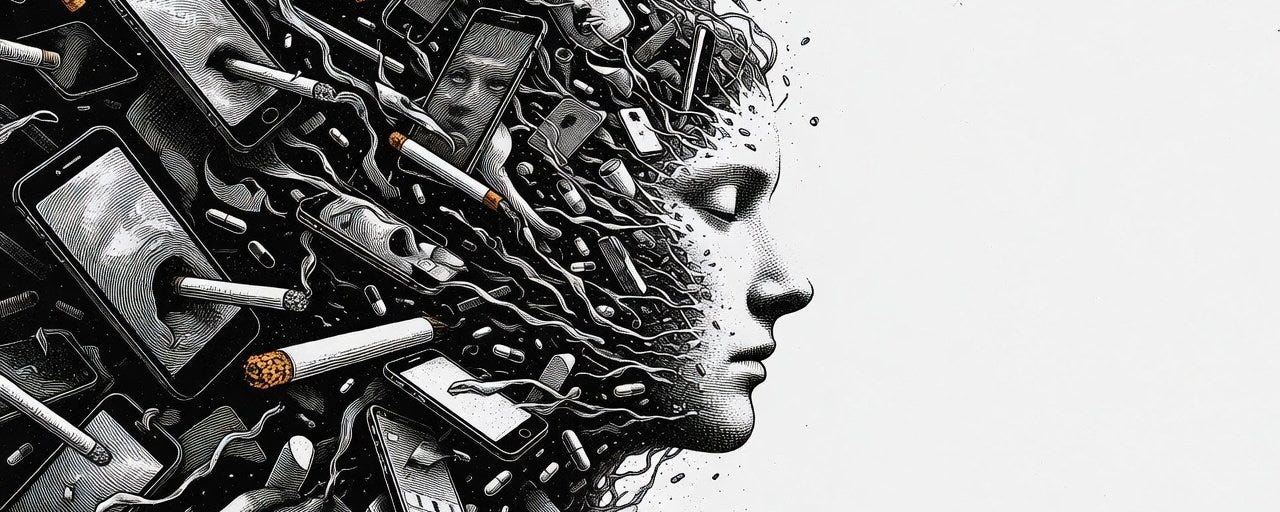
How many "last packs" has this been? Or maybe cigarettes aren't your thing. Maybe every evening starts with "just one glass" and ends with the bottle empty. Maybe you get into bed saying "five minutes on Instagram," and when you look up it's past 2 a.m. Maybe you can't leave the table without dessert. Maybe you "can't sleep" without weed. Maybe it's porn, maybe it's gambling. The name changes, the feeling doesn't: you know you shouldn't, but you can't stop yourself.

You know the loop. You quit. You hold out for a few days. Then a bad day comes: stress, an argument, loneliness. And you go back. Guilt. “I’m weak.” Then you try not to think about it for a while. Then you try again. You fail again. Each cycle is heavier than the last. Because now you’re not just fighting your addiction, you’re also fighting the identity of “the person who couldn’t do it.”
Millions of people are inside this loop. The intention is there, the strength isn’t. Every attempt turns into a failure story. And every failure makes the next attempt even harder.
So why is it this hard?
Because you’re starting with the wrong question. You ask, “How do I quit this?” But there are two questions you should be asking instead: “What is this thing actually giving me?” and “Why does my brain need an escape this badly?”
The moment you understand the answers to these two questions, you no longer need willpower to quit. Knowledge becomes enough.
In this article I’m going to show you three things.
First: what addiction does inside your brain, exactly. You’ll see the neurological mechanism laid bare. Cigarettes, alcohol, social media, porn, weed, gambling: they all run on the same mechanism.
Second: I’ll explain Allen Carr’s method, which has helped more than 50 million people quit smoking, and where that method falls short.
Third: I’ll give you a protocol that completes what Carr’s method leaves out, using neuroscience, evolutionary psychology, Adlerian psychology, and the science of connection.
It doesn’t matter what your addiction is. The mechanism is the same. So is the solution.
If you’re ready, let’s begin.
The Anatomy of Addiction: The Common Enemy in Your Brain
To understand your addiction, you first have to understand your brain. And to understand your brain, you have to understand dopamine.
Dopamine is not the “happiness hormone.” That’s a common misconception. Dopamine is the neurotransmitter of motivation and anticipation. It’s the brain’s “do this again” signal. It’s less about the pleasure you feel and more about the chemical that makes you seek something again.
In a healthy brain, dopamine comes from natural sources: a deep conversation with a friend, making progress on a project, the satisfaction after a workout, locking eyes with someone you love. These are moderate, sustainable dopamine sources.
Now look at what addiction sources do.
Nicotine reaches the brain within 10 seconds through cigarette smoke and creates a dopamine surge. Alcohol activates the GABA system, lowering inhibition and raising dopamine. Sugar stimulates opioid receptors, releasing both dopamine and endorphins. Social media notifications trigger dopamine constantly through intermittent reinforcement, the uncertainty of “sometimes there’s a reward, sometimes there isn’t.” Porn exploits the novelty-seeking drive, spiking dopamine with every new image. THC (weed) raises dopamine indirectly through the endocannabinoid system. Gambling pumps dopamine through the anticipation of winning; even when you lose, the feeling of “almost” is enough.
The tool is different. The mechanism is the same: a dopamine surge far faster and more intense than any natural source.
And the brain does the same thing every time: to protect itself from this overstimulation, it reduces receptor sensitivity and lowers your baseline dopamine level. This is called neuroadaptation. What it means in practice: whenever you’re not using your addiction source, your normal dopamine level is now lower than it used to be. Your “normal” state, your pre-addiction self, now feels incomplete, boring, restless.
When you light the cigarette, raise the glass, open the phone, bite into the dessert, dopamine rises. “Ah, I needed that,” you say.
But stop. Notice something critical: that thing isn’t giving you anything. It’s only filling the deficit it created. It pulls you below zero, then brings you back to zero. It adds nothing on top. Someone who never started already lives at that zero, every moment, without any effort.
This is true for cigarettes, for alcohol, for sugar, for social media. This is their shared anatomy. And understanding this anatomy is the first step to quitting.
What Allen Carr Did: The Man Who Saw the Trap
Allen Carr was a British accountant and a 100-a-day chain smoker. In 1983, at age 48, after countless failed attempts, he realized something: cigarettes weren’t giving him pleasure. They were only relieving the withdrawal they themselves created. And that realization changed everything.

Carr turned this discovery into a method and dedicated the rest of his life to helping others quit. The core of his method was a single proposition: your addiction source gives you nothing. It only fills the void it creates. The moment you break this illusion, quitting becomes easy.
Carr didn’t stop at smoking. He applied the same logic to alcohol, drugs, sugar addiction, gambling, emotional eating, caffeine, even fear of flying. He wrote separate books and ran seminars for each one. Because the structure of the trap was identical in all of them: a loop that promises a fake reward while “solving” the very problem it creates.
There are no scare tactics in his method. No photos of blackened lungs or damaged livers. No demand for willpower. No pills, patches, or hypnosis. Instead, he systematically dismantles the illusion that your addiction source gives you anything at all.
He even rejects the word “quitting.” Quitting implies sacrifice, giving something up. Carr calls it “escape” instead. You’re breaking out of a trap. You’re not losing, you’re winning.
And it works. Carr’s clinics report a 90 percent three-month success rate on a money-back guarantee basis, and a 51 percent twelve-month success rate. The method spread to more than 150 clinics in over 50 countries, was translated into 38 languages, and has helped more than 50 million people quit. In 2021, the UK’s NICE reviewed Allen Carr’s method, found it clinically effective and cost-effective, and approved it for use by the national health service, the NHS.
The numbers are impressive. The method is genuinely powerful.
But there’s a question: why isn’t it 100 percent?
A 51 percent twelve-month success rate means nearly half go back within a year. Carr’s method breaks the illusion, yes. But why do some people return to their old addiction even after the illusion is broken?
Because there’s a missing piece.
Carr Is Right but Incomplete: Breaking the Illusion Isn’t Enough
Carr proves that the “pleasure” your addiction gives you is fake. We confirmed it neurologically too: the thing brings the dopamine it pushed below zero back to zero, and adds nothing on top. Carr is right.
But Carr’s model doesn’t answer one question: why does the brain need a fake reward this badly?
If breaking the illusion were enough, everyone who read the book would quit permanently. But they don’t. Because some people’s brains can’t get dopamine from anywhere else without the addiction source. The real dopamine sources in their lives have dried up. And the brain cannot tolerate a void.
The experiment that shows this best was done in the 1970s: Canadian psychologist Bruce Alexander’s Rat Park.

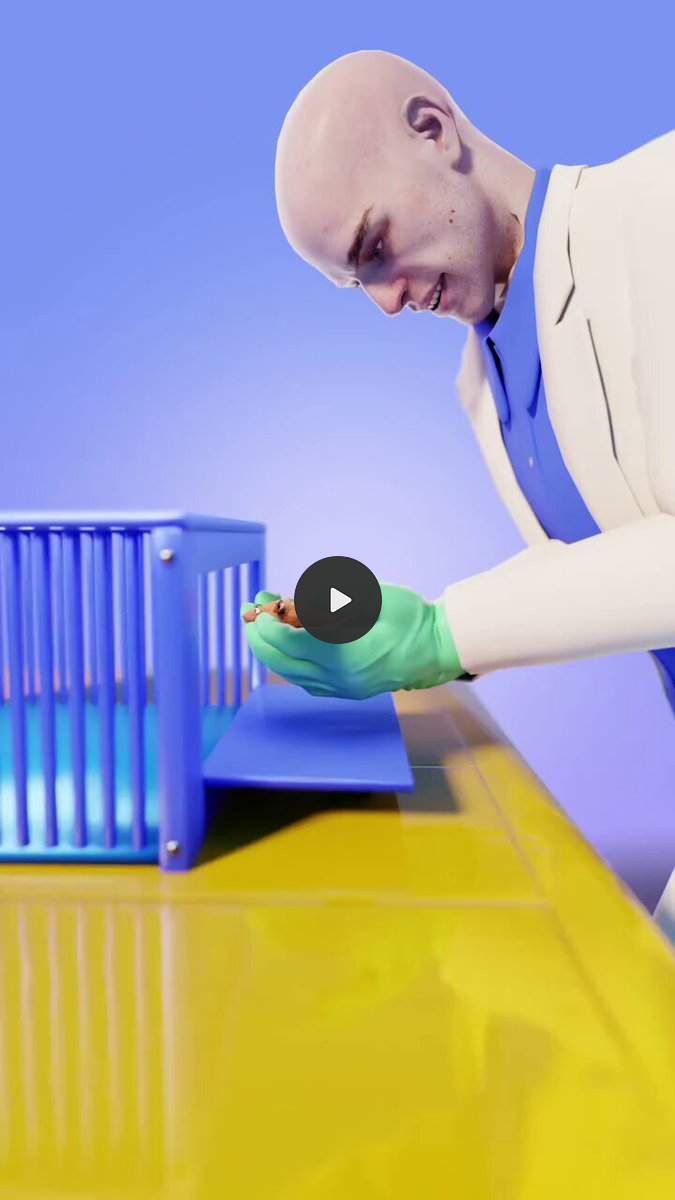
In the classic experiments, a rat is placed alone in an empty cage. It’s given two bottles: plain water and morphine water. The rat prefers the morphine water and drinks until it kills itself. The scientists conclude: “See, the substance is addictive.”
Alexander asked a different question: “Is the rat drinking because it has no other option?”
So he built Rat Park. A large space with tunnels, toys, running wheels, and most importantly, other rats. Friends. Mates. A social life.
The result? The rats in Rat Park barely touched the morphine water. Even rats that had previously been made dependent on morphine voluntarily gave it up once they were placed in Rat Park.
Same substance. Same rats. Different cage. Different outcome.
Now apply this to a human. Picture someone with a weak social circle. No one to have deep conversations with. A job that feels meaningless. Alone at home. Their only “ritual” is the cigarette break, or the evening beer, or the Instagram scroll, or porn before bed.
This person reads Carr’s book, says “this thing gives me nothing,” and quits. But what happens three months later? A stressful day arrives. Loneliness hits. The brain reaches for the old escape. Because the cage hasn’t changed. The morphine bottle was removed, but the cage is still empty.
Adler’s Missing Piece: Why You Need the Fake Reward
Alfred Adler, the founder of individual psychology, introduced a concept in the early 1900s: Gemeinschaftsgefühl. Community feeling. The sense of belonging.
For Adler, this feeling sits at the center of human psychology. When a person feels they belong to a community, contributes to a purpose, and forms meaningful bonds with others, they are psychologically healthy. When they lose this feeling, every kind of pathology emerges, and addiction is the most common of them.
Seen through Adler’s framework, addiction is not a disease but a compensation mechanism. It’s the unhealthy path a person takes to fill the void left by lost community feeling.
You can see it in every addiction:
Why does smoking “relax” you? Because it gives you a ritual. You step out for a break, maybe chat with someone, you’re “doing something.” A counterfeit moment of connection.
Why is alcohol an escape? Because when you drink, your social anxiety drops and you feel like you can “connect” with people. You believe you can be intimate when you’re drunk. A counterfeit closeness.
Why is social media addictive? Likes, comments, notifications: counterfeit belonging signals. Your brain can’t tell real connection from fake.
Why is sugar a comfort? Because since childhood it’s been paired with reward and love. When you feel lonely, a slice of cake is a counterfeit hug.
Why is porn a trap? Because when real sexual and emotional intimacy is missing, the brain clings to a virtual version.
Why is gambling seductive? Because the feeling of “I almost won” creates an illusion of achievement and competence. A counterfeit moment of victory for the person who can’t find their worth recognized in society.
Underneath every addiction lies the same void: missing connection. The relentless pursuit of a fake reward is a response to the absence of the real one: belonging, intimacy, meaning.
This is Carr’s missing piece. Carr says the pleasure of addiction is fake. True. But Adler goes one step further back: “Why does a person need fake pleasure in the first place? Because their sources of real pleasure have dried up.”
Carr shows you the trap. Adler shows you why you fell into it. Put the two together and you see the full picture.
The Neurological Evidence: Connection Repairs the Brain
There’s a reason for this. The human brain evolved over 200,000 years in small tribal groups. Communities of 50 to 150 people. Exile from the tribe meant death: a lone human couldn’t hunt, couldn’t stay protected, couldn’t reproduce. So the brain encoded the signal of “separation from the group” as pain.
Neuroimaging studies confirm it: social exclusion activates the same brain regions as physical pain. To the brain, loneliness is a survival alarm. And addiction is an attempt to silence that alarm. This evolutionary inheritance takes Adler’s Gemeinschaftsgefühl out of the realm of abstract ideas and turns it into a 200,000-year-old biological fact. Humans don’t just “need” connection. Humans are built for it.
This isn’t just philosophy. Neuroscience says the same thing.
Real, face-to-face, meaningful human connection triggers the release of oxytocin and endorphins in the brain. Oxytocin is known as the “bonding hormone,” directly tied to trust, closeness, and belonging. But here’s the more critical part: oxytocin modulates the dopamine system. When you connect, your baseline dopamine naturally recovers. Without any artificial source.
Look at it from the other side: social isolation raises chronic cortisol. Chronic cortisol blunts dopamine receptors. So the lonely person gets less dopamine from natural sources. And the brain turns to intense, artificial sources to close the gap.
This is not a choice. It’s a neurochemical necessity.
This is why Carr’s method works permanently for some people and not for others. A person with connection in their life can quit for good once the illusion breaks, because their brain is already producing dopamine from other sources. A person without connection goes back even after the illusion breaks, because their brain can’t find any other source to fill the pit.
Carr is right: addiction is an illusion. But breaking the illusion alone isn’t enough. You have to put the real thing where the illusion used to be. And the real thing is called connection.
The Full Protocol: Exiting Addiction Through Knowledge and Connection
Now let’s put everything together. I’ve combined the neurological mechanism, Carr’s cognitive reframing, and Adler’s connection theory into a single protocol. Let’s call it the Knowledge and Connection Protocol.
The protocol has six stages. Each stage builds on the one before it. Whether your addiction is cigarettes, alcohol, or your phone, the protocol is the same.
Stage 1: Learn the Mechanism (Carr’s Foundation)
The first step is knowledge. Understand exactly what your addiction does to your brain:
Your addiction source, whether it’s nicotine, alcohol, sugar, or social media, creates a dopamine surge far above natural levels. The brain adapts to this surge by reducing receptor sensitivity and lowering baseline dopamine. The moments when you’re not using now feel “incomplete.” This is not your normal state. It’s an artificial pit dug by the addiction itself. When you use, you climb from the pit back to zero. Nothing gets added on top. Someone who never used already lives at that zero, every moment, effortlessly.
Don’t just read this information. Internalize it. In every moment of craving, tell yourself: “This thing gives me nothing. It’s filling the pit it dug. A non-addicted person already feels the ‘relief’ I’m feeling right now, all the time.”
This is Carr’s genius: quitting is not a loss, it’s a gain. You’re not being deprived of something. You’re escaping a trap.
Stage 2: Break the Fear
A brain that’s afraid of quitting cannot quit. The fear usually comes from thoughts like: “What if I can’t take it and lose my mind?” “What if I can never feel at ease without cigarettes, alcohol, my phone?” “What if I feel awkward in social settings?” “What if I replace it with something worse?”
Dissolve each of these fears with knowledge:
The most intense period of physical withdrawal symptoms is the first 72 hours. Three days. That’s how long it takes the brain to start finding its new equilibrium. Intense craving waves last three to five minutes on average. They are not eternal. A wave comes, and it passes. Each wave that passes weakens the next one. The fear of “I’ll replace it with something worse” is real, if you don’t fill the void. That’s exactly why every stage matters.
But pay attention here: there’s a fear deeper than the physical one. The fear of emptiness. The question “what will I do without this thing?” is really the question “what will fill the void in my life?” And that takes us to the most important part of the protocol.
Stage 3: Know Your Cage (Adler’s Foundation)
Carr broke the illusion. You’ve dissolved the fear. But if you quit without filling the connection void in your life, your brain stays in the pit, and sooner or later you go back. So take an honest look at your cage, your life conditions.
How many people do I regularly have deep conversations with? Don’t count WhatsApp groups. Count the people you truly talk to, who listen to you, whom you listen to.
How many hours a week do I spend in face-to-face, screen-free social interaction?
Is there a community I feel I belong to? A sports group, a hobby club, a regular meetup, a neighborhood connection?
Is there a purpose or project that excites me, something I get up for in the morning?
If your answer to most of these is “no,” you’re living in Rat Park’s empty cage. And in an empty cage, willpower, and even Carr’s cognitive reframing, won’t hold in the long run. You have to fill the cage.
Stage 4: Build Connection
Start this stage before you quit, or in parallel as you quit. Don’t think big. Start small:
Daily micro-connections: Call a friend. Not a text, a voice call. Even two minutes is enough. Make eye contact with a stranger and smile, at the cafe, at the store, on the street. Eat with someone, not alone.
Weekly macro-connections: Join a group. A running club, a book club, a volleyball team, a chess community. What it is doesn’t matter. What matters is that it’s regular and it’s genuinely your interest.
Recode the trigger: Every addiction has a trigger. Cigarettes: stress, boredom, after meals, with coffee. Alcohol: after work, social settings, lonely evenings. Phone: getting into bed, elevators, boredom. Sugar: emotional dips, celebrations, the need for a reward.
Don’t try to destroy the trigger. Recode it. In a moment of stress, call someone instead of smoking. On a lonely evening, invite a friend over instead of drinking. In bed, talk to the person next to you instead of scrolling, or get up and do pull-ups at every trigger. In an emotional dip, go outside, walk, text someone instead of reaching for dessert. Did you notice? Every alternative is an act of connection. That’s not a coincidence. Addiction is counterfeit connection. The cure is real connection.
The neurological counterpart: every real connection produces oxytocin and natural dopamine. Your baseline dopamine rises. The withdrawal waves weaken. The brain learns it can reach that zero point without an artificial source.
Stage 5: Get a Purpose
One of Adler’s most powerful ideas: a person becomes psychologically solid when they serve a purpose. A person without purpose is defenseless.
Your purpose doesn’t have to be grand. You don’t have to say “I’m going to save the world.” But you should be moving in a direction. Learning a skill. Running a project. Mentoring someone. Building a community. Writing a book. Starting a business.
Purpose shifts the brain from escape mode to build mode. A brain in build mode needs addiction less, because it’s producing dopamine from a meaningful source.
This is Rat Park’s toys and tunnels. The rats didn’t touch the morphine water not only because they had friends, but also because they had things to do.
Stage 6: Environmental Design
Rat Park made one thing crystal clear: your environment determines your behavior. Not your willpower. Your environment.
Physically remove the addiction source. Take the cigarettes, the lighter, the ashtray out of the house. Remove the alcohol bottles. Delete the social media apps. Clear the sugary snacks out of the kitchen cabinet.
But removing alone isn’t enough. Put a morning breathing exercise where the cigarette ritual used to be. Make a good cup of tea instead of the evening drink. An e-book app instead of social media. A plate of fruit instead of candy.
Environmental design overrides willpower. Physically change your cage.
Why This Time Will Be Different
I know you’ve tried before and failed. Maybe you read Carr’s book, quit for a while, went back. Maybe you tried cold turkey. Maybe you tried medication.
Here’s what’s different this time: now you know the full mechanism.
You know the neurological dimension: your addiction source lowers your baseline dopamine, and using it only fills the pit it dug. Natural dopamine sources can close that pit permanently.
You know the cognitive dimension: as Carr showed, that thing gives you nothing. Quitting is not a loss, it’s liberation. There is nothing to fear.
You know the psychological dimension: as Adler showed, addiction is compensation for disconnection. Without enriching your cage, you’ll go back even after breaking the illusion. When you build connection, there’s no reason left to go back.
When the three dimensions work together, willpower becomes unnecessary. You don’t “quit” the addiction. You graduate from it. Just like you used a pacifier as a child and one day simply stopped needing it. Nobody spent willpower giving up their pacifier. You just grew, and the need disappeared.
The same applies here. Except here, growing means knowledge and connection.
Final Word: The Cage Does Not Define You
You might be in an empty cage right now. You might be lonely, purposeless, disconnected. Cigarettes, alcohol, your phone, sugar, porn, gambling: these are your responses to the emptiness of your cage. Symptoms of your void, not your weakness.
But the cage is not fixed. Alexander’s rats showed us: when the cage changes, the behavior changes. Adler said it a hundred years ago: when community feeling is built, the need for compensation mechanisms disappears. Carr proved it: when the illusion breaks, the addiction loses its power.
Now combine all three.
Break the illusion: that thing gives you nothing. Dissolve the fear: quitting means becoming free. And then change your cage: build connection, find a purpose, enrich your life.
Your addiction is sending you a message: “Something is missing in your cage.”
Hear that message. The antidote is not at the pharmacy. Not in willpower. Not in the nicotine patch, the detox program, the diet plan.
The antidote is in knowledge and connection. It always was.
Enrich your cage. Or the cage will kill you.
-Can